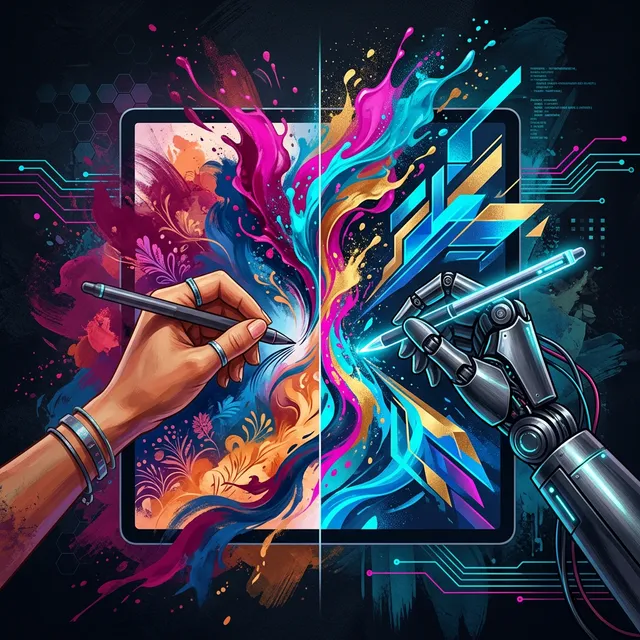
A machine-learning model called AIVA—Artificial Intelligence Virtual Artist—composed a symphonic piece in 2023 that was performed by a live orchestra in Luxembourg. The audience applauded. Music critics, who had not been informed that the composer was an algorithm, described the piece as "technically accomplished" and "emotionally resonant." When the AI authorship was revealed, the critical assessment split along predictable lines: some listeners revised their evaluation downward ("knowing it's AI-generated, I can hear the lack of genuine emotion"), while others maintained or even elevated their assessment ("if the music moved me before I knew its origin, the origin doesn't change the music"). This split reveals the fundamental question that AI creativity poses—a question that is not about technology, not about aesthetics, and not about copyright, but about what we believe creativity actually is and why we value it.
The debate about AI and human creativity is not new—it is the latest iteration of a philosophical argument that has recurred with every technology that has enabled humans to produce creative output with less effort: the camera (which was accused of destroying painting), the synthesizer (which was accused of destroying musicianship), the word processor (which was accused of making writing too easy), and Photoshop (which was accused of making photography a lie). Each of these technologies eventually found its place—not by replacing the human creative act but by redefining what constitutes creative value in the medium. Photography did not destroy painting; it liberated painting from the obligation to represent reality accurately, enabling abstract expressionism and conceptualism. The relevant question is not "will AI destroy human creativity?" but "how will AI redefine what we value in human creative work?"
What AI Actually Does When It "Creates"

Understanding what AI creative tools actually do—mechanistically, mathematically—is essential to having an honest conversation about their implications. A large language model like Claude or GPT-4 does not "imagine" a story, "feel" the rhythm of a sentence, or "understand" the theme it is exploring. It performs a mathematically sophisticated form of pattern completion: given a sequence of tokens (words, word-fragments), it predicts the most probable next token based on statistical patterns learned from its training data. The outputs are genuinely remarkable—coherent narratives, evocative descriptions, structurally sound arguments—but they are produced by pattern recognition and probabilistic prediction, not by anything resembling human consciousness, intention, or emotional experience.
Image generation models (DALL-E, Midjourney, Stable Diffusion) operate through a process called diffusion: they begin with random noise and iteratively refine it, guided by a text prompt, until the noise resolves into an image that aligns with the patterns the model learned from its training data (millions of captioned images scraped from the internet). The resulting images can be stunningly beautiful, technically accomplished, and emotionally evocative. But the model does not "see" the image, does not "choose" compositional elements for aesthetic reasons, and does not "intend" to communicate anything. It is performing a mathematical optimisation over pixel values, constrained by learned statistical associations between text descriptions and visual patterns.
This mechanistic description is not intended to diminish the impressiveness of AI creative output—it is intended to establish what is actually happening so that the subsequent discussion about value, meaning, and creativity can proceed on honest foundations. The outputs are remarkable. The process that produces them is fundamentally different from human creative processes, and this difference matters—though reasonable people disagree about how much it matters and why.
The Value Question: Does Origin Determine Worth?
The AIVA experiment illuminates a question that philosophers of art have debated for centuries but that AI has made practically urgent: does the origin of a creative work affect its aesthetic or emotional value? If a poem moves you to tears and you later discover it was generated by an algorithm, does it retroactively become less moving? Does the emotional response you experienced become invalid? If a painting is indistinguishable from a human-created work and provokes identical emotional responses in viewers, does the absence of human intention behind it make it less valuable as art?
There are two coherent positions, and they are genuinely irreconcilable. The formalist position argues that aesthetic value resides in the work itself—in the arrangement of words, sounds, colours, shapes—independent of the process or intention behind its creation. If a sunset is beautiful, its beauty does not depend on any intention behind its creation. If a machine-generated poem achieves the same formal qualities (rhythm, imagery, emotional resonance) as a human-written poem, the formalist argues that the poems have equal aesthetic value regardless of their origin. The intentionalist position argues that creative value is inseparable from human intention, experience, and vulnerability. A human poet who writes about grief draws on their actual experience of loss, takes the emotional risk of exposing that experience to scrutiny, and makes deliberate choices about how to structure that experience into language. An AI that generates text about grief is performing pattern completion using statistical associations; it has not experienced loss, taken emotional risks, or made intentional choices. The intentionalist argues that real creative value requires these human elements and that their absence makes AI-generated work fundamentally empty regardless of its surface qualities.
Both positions are internally consistent. The tension between them is not a problem to be solved but a genuine philosophical disagreement about the nature of aesthetic value—one that AI has not created but has made impossible to ignore.
What AI Cannot Do (Yet, and Perhaps Ever)
The capabilities that AI creative tools currently lack are precisely the capabilities that define the most valued forms of human creative achievement. Genuine novelty—the creation of something that is not a recombination of existing patterns but a genuine departure from them—remains beyond AI's demonstrated capability. AI can produce work that is novel in the sense of being a combination that has not previously existed, but it cannot produce work that is novel in the sense of representing a new aesthetic paradigm, a new formal approach, or a new way of seeing. Picasso did not paint Cubist works by recombining existing painting patterns; he invented a new visual language that violated existing patterns. AI, which generates outputs by interpolating within the space defined by its training data, is structurally incapable of this kind of paradigm-breaking novelty—it can produce infinite variations within the existing space but cannot expand the space itself.
Intentional meaning—the embedding of specific ideas, emotions, arguments, or provocations into a creative work—is another capability that AI fundamentally lacks. A human artist who creates a painting about climate change is making a statement: they have an intended message, an emotional commitment to that message, and a willingness to defend the choices they made in expressing it. An AI that generates an image of melting glaciers in response to the prompt "climate change art" has no intended message, no emotional commitment, and no understanding that the image has semantic content beyond its visual properties. The image may be visually identical to the human-created work, but it lacks the intentional dimension that allows us to interpret, critique, and engage with art as a form of communication between minds.
The Practical Creative Landscape in 2026
While the philosophical debate continues, the practical creative landscape has already been transformed. AI tools have democratised certain forms of creative production that were previously gatekept by skill barriers. A person who cannot draw can now generate publication-quality illustrations. A person who cannot play an instrument can now compose music. A person who struggles with written expression can now produce polished prose. This democratisation is genuinely valuable: it enables creative expression by people who have ideas, stories, and visions but lack the specific technical skill to execute them in traditional media.
The professional creative economy is adapting rapidly, though the adaptation is painful for some practitioners. Commercial illustration—particularly stock illustration, product visualisation, and marketing imagery—has been significantly disrupted by AI image generation, with freelance illustrators reporting substantial revenue declines. Music composition for commercial purposes (advertising jingles, background music, podcast intros) is increasingly AI-generated. Content writing for SEO, product descriptions, and routine marketing copy has been substantially automated. In each case, the pattern is consistent: AI replaces creative work that is primarily functional (serving a specific commercial purpose) before it replaces creative work that is primarily expressive (communicating personal vision, exploring emotional truth, challenging audience assumptions).
The creators who are thriving in the AI era are those whose work has a strong authorial voice, personal perspective, and experiential authenticity that cannot be replicated by pattern completion. A food writer who has actually eaten at the restaurant, an essayist who has actually lived through the experience they describe, a photographer who has actually stood in the landscape they captured, a musician who has actually felt the emotion their performance expresses—these creators provide something that AI cannot provide: the guarantee that a human consciousness has processed, interpreted, and communicated reality through the filter of genuine subjective experience.
Frequently Asked Questions (FAQs)
Is AI-generated art "real" art?
This question depends entirely on your definition of "art." If art is defined by its formal properties—visual beauty, emotional resonance, compositional sophistication—then AI-generated imagery that achieves these properties qualifies. If art is defined by the process of its creation—human intention, emotional investment, creative struggle, the expression of subjective experience—then AI-generated imagery does not qualify, regardless of its visual quality. Both definitions have philosophical legitimacy. The practical resolution in most contexts is not to determine whether AI art is "real" but to be transparent about its origin: label AI-generated work as such, allow audiences to form their own judgments about its value relative to human-created work, and recognise that the two categories of creative production serve different functions and carry different meanings.
Will AI replace human artists and writers?
AI will replace specific categories of creative labour—particularly commercial, functional creative work where the primary value is the output rather than the process or the creator's identity. Stock photography, routine copywriting, generic illustration, and formulaic content creation are already being automated. AI is unlikely to replace creative work whose value is inseparable from human authorship: literary fiction, personal essays, fine art, documentary photography, investigative journalism, and any creative form where the audience's engagement depends on knowing that a human consciousness produced the work. The human artist's competitive advantage is not technical skill (AI can match or exceed technical skill in many domains) but authenticity, perspective, and the irreplaceable credibility of human experience.
Should I use AI tools in my creative work?
Using AI as a creative tool—for brainstorming, drafting, iteration, exploring possibilities, overcoming creative blocks—is a legitimate and increasingly common practice. The ethical boundary is transparency: if you present the final work as your own creation, you should have contributed substantial creative direction, editing, selection, and refinement. Using AI to generate a first draft that you then extensively revise, restructure, and imbue with your personal perspective is analogous to using a camera to capture raw imagery that you then process, crop, and sequence into a photographic narrative—the tool contributes capability but the creative authorship resides in your choices and judgment. Using AI to generate finished work that you submit as your own without substantial modification is, in most professional and academic contexts, dishonest.

Comments (0)
Be the first to share your thoughts on this article.