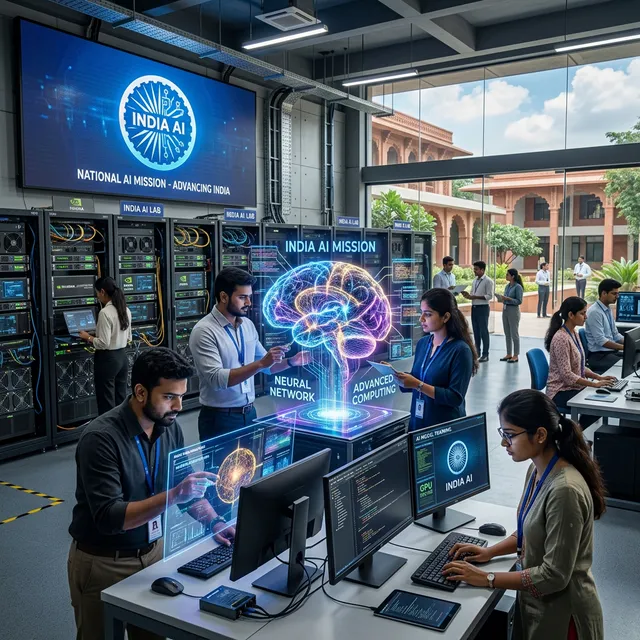
In March 2023, India's Prime Minister announced the India AI Mission with an initial outlay of ₹10,372 crore, positioning artificial intelligence as a "national strategic priority." The announcement generated headlines that ranged from breathlessly optimistic ("India will lead the global AI revolution") to dismissively skeptical ("Another government mission that will produce committees, not code"). Both reactions miss the genuinely interesting, genuinely complex reality of India's AI landscape in 2026: a country with extraordinary natural advantages for certain categories of AI development, severe structural disadvantages for others, and a strategic calculus that is fundamentally different from the AI strategies pursued by the United States and China.
Understanding India's AI position requires abandoning the simplistic framework of a "global AI race"—a narrative that implies every country should be competing to build the largest foundation model with the most parameters. India is not going to build GPT-5. India is not going to compete with Google DeepMind on frontier research. And that is not a failure; it is, potentially, a profoundly intelligent strategic choice. India's AI opportunity lies not in building the models but in building the applications—deploying AI to solve problems of a scale, complexity, and social diversity that exist nowhere else on Earth.
The India AI Mission: What It Actually Proposes

The India AI Mission, operationalized through the India AI (IndiaAI) initiative under the Ministry of Electronics and Information Technology, has four primary structural components that collectively define the government's approach to AI development:
Compute Infrastructure: The mission's most tangible investment is in building domestic AI compute capacity. India currently lacks large-scale GPU clusters of the kind that are required for training and fine-tuning large language models and other computationally intensive AI systems. The plan involves establishing "AI compute centers" with 10,000+ GPU capacity through public-private partnerships, providing subsidized compute access to Indian AI startups, academic researchers, and government agencies. The strategic logic is straightforward: without domestic compute infrastructure, every Indian AI researcher and company is dependent on cloud services provided by American hyperscalers (AWS, Google Cloud, Microsoft Azure), creating a critical dependency on foreign infrastructure for a technology classified as strategically important.
Data Platform (India Datasets Program): The mission envisions creating curated, high-quality, multilingual datasets specifically designed for training AI models on Indian contexts—Indian languages, Indian agricultural conditions, Indian healthcare scenarios, Indian administrative procedures. The rationale is compelling: global AI models trained primarily on English-language internet data perform poorly on Indian-language tasks, misunderstand Indian cultural contexts, and lack the domain-specific training data needed for applications in Indian agriculture, healthcare, and governance. Building Indian AI applications on Indian data is both a practical necessity and a strategic asset.
Application Development (AI for Social Good): The mission prioritizes AI deployment in six "domains of national importance"—healthcare, agriculture, education, smart cities, infrastructure, and language translation. This application-first strategy reflects India's pragmatic assessment that its comparative advantage lies not in frontier model research but in the deployment of AI at scale to solve the specific, complex, enormously impactful problems of governing and serving a population of 1.4 billion across extraordinary diversity.
Skilling and Talent Development: India produces more computer science and engineering graduates than any country on Earth—approximately 1.5 million engineering graduates annually. However, the gap between a graduating engineer and an AI-ready researcher or practitioner is significant: it requires specialized training in machine learning, deep learning, natural language processing, computer vision, and the mathematical foundations (linear algebra, probability theory, optimization) that underpin these techniques. The mission includes dedicated AI skilling programs at IITs, IIITs, and through industry partnerships aimed at building a domestic AI talent pipeline that can support both research and commercial deployment.
Where India Has Genuine, Structural AI Advantages
The Scale of Problems: India's challenges—agricultural advisory for 100 million smallholder farmers cultivating hundreds of crop varieties across dozens of agro-climatic zones; healthcare screening and diagnosis in 600,000 villages with limited medical infrastructure; government service delivery in 22 official languages and dozens of dialects; financial inclusion for 400 million informal sector workers—are problems of a scale and complexity that simply do not exist in smaller, more homogeneous countries. AI systems trained to operate effectively in these environments—with variable internet connectivity, extreme linguistic diversity, heterogeneous data sources, and resource-constrained deployment conditions—develop a robustness and adaptability that makes them potentially applicable across developing countries worldwide. An agricultural AI system that works in Indian conditions may transfer more effectively to sub-Saharan Africa than an equivalent system designed for Iowa's monoculture corn farms.
Talent Depth (If Not Talent Retention): India produces extraordinary AI talent. Indian researchers and engineers hold prominent positions across virtually every major AI research lab and technology company globally—Google Brain, DeepMind, OpenAI, Microsoft Research, Meta AI. The challenge is not talent production but talent retention: the most exceptional AI researchers—those capable of frontier model research, novel architectural innovation, and breakthrough publications—are recruited by American companies at compensation packages that Indian institutions and companies cannot match. An IIT graduate specializing in machine learning can expect an entry-level package of ₹20-40 lakh from an Indian company, or $150,000+ (approximately ₹1.25 crore) from a US-based AI lab. The economic gravity pulling India's best AI talent toward foreign institutions is enormous and will not be overcome by patriotic appeals alone—it requires creating domestic research environments with adequate compute resources, meaningful problems, intellectual freedom, and competitive (if not matching) compensation.
Data Diversity as Training Advantage: India's population generates data across conditions—urban/rural, 22 major languages and hundreds of dialects, diverse economic levels, tropical/temperate/arid climatic zones, vastly different healthcare environments—that create opportunities for training AI models that are robust, generalizable, and adaptable across varied contexts. A healthcare AI model trained on Indian medical imaging data—covering conditions prevalent in tropical climates, rural healthcare settings with limited diagnostic equipment, and resource-constrained environments—has potential application across developing countries in Asia, Africa, and Latin America where healthcare conditions are more similar to India's than to the high-resource clinical environments where most Western medical AI models are developed.
The Honest Structural Gaps
Compute Access Remains a Critical Bottleneck: Training a large language model comparable to GPT-4 requires computational resources valued at $50-100 million per training run, using thousands of high-end GPUs running continuously for weeks. India's domestic compute capacity—whether government, academic, or commercial—does not yet support training runs at this scale. The India AI Mission's compute infrastructure investment is a necessary first step, but the gap between India's current capacity and the frontier remains enormous. India's AI ecosystem will remain dependent on cloud-based compute from American hyperscalers for the foreseeable future, which creates strategic vulnerability and economic leakage.
Regulatory Framework in Development: India is simultaneously developing AI governance frameworks while attempting to accelerate AI deployment—a challenging dual mandate. The intersection of AI deployment with India's Aadhaar biometric infrastructure (which covers 1.3 billion enrolled individuals and underpins identity verification, benefit delivery, and financial services) raises profound privacy and surveillance questions. An AI system with access to Aadhaar-linked data—financial transactions, healthcare records, government benefit histories, biometric identifiers—possesses a surveillance capacity of extraordinary granularity. India's data protection legislation (the Digital Personal Data Protection Act, 2023) establishes foundational privacy principles, but the specific regulatory framework governing AI's interaction with sensitive personal data remains under development. This regulatory ambiguity creates genuine risk for both citizens and AI developers.
Frequently Asked Questions (FAQs)
Can India build its own large language model comparable to ChatGPT?
India can build and is building Indian-language AI models—projects like Bhashini (AI-based translation across Indian languages), AI4Bharat (IIT Madras consortium developing Indian-language NLP tools), and Krutrim (Ola founder Bhavish Aggarwal's AI startup) are producing multilingual models specifically designed for Indian contexts. However, these models are not comparable to GPT-4 or Claude in general capability because they are trained on smaller compute budgets with less data. India's strategic focus should be on fine-tuning large models for Indian applications rather than training frontier models from scratch—this is both more cost-effective and more aligned with India's comparative advantage.
Will AI create or destroy jobs in India?
Both, simultaneously, in different sectors. AI will likely displace jobs in business process outsourcing (BPO), basic IT services, customer support, and routine data processing—sectors that currently employ millions of Indians. Simultaneously, AI deployment will create new jobs in AI system development, data annotation, model training, AI-assisted healthcare, precision agriculture, and AI-powered education. The net employment effect depends critically on whether India's education and skilling systems can retrain displaced workers for AI-adjacent roles fast enough to prevent prolonged unemployment. Historical technology transitions have always been net-positive for employment in the long run, but the transitions themselves can be economically devastating for specific communities and age cohorts.
How will AI affect India's IT services industry—the traditional engine of Indian technology employment?
India's IT services industry (TCS, Infosys, Wipro, HCL Technologies, Tech Mahindra)—which employs over 5 million people directly and generates approximately $250 billion in annual revenue—faces an existential strategic question. These companies currently earn the majority of their revenue from labour-intensive services: software development, application maintenance, business process management, and IT infrastructure support. AI tools that automate significant portions of these tasks threaten the labour-intensive business model. The companies are responding by investing heavily in AI-powered service delivery, retraining their workforce for AI-augmented roles, and positioning themselves as AI implementation partners for global enterprises. The transition will be turbulent—hiring patterns have already shifted from volume recruitment to selective, skills-based recruitment—but the industry's survival instinct, adaptability, and client relationships provide a reasonable basis for cautious optimism.



Comments (0)
Be the first to share your thoughts on this article.