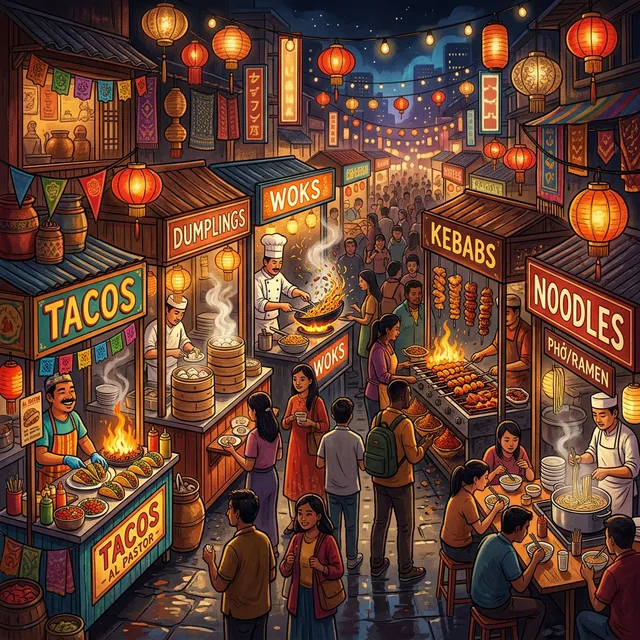
There is a hierarchy in the food world that restaurant critics and culinary guidebooks enforce with quiet persistence: fine dining at the top, casual dining in the middle, and street food at the bottom—tolerated as colourful, affordable, and "authentic," but fundamentally inferior to food prepared in a kitchen with a brigade de cuisine, a sommelier, and tablecloths. This hierarchy is, in my experience of eating obsessively across four continents, almost exactly inverted. The most memorable, most technically accomplished, most spiritually satisfying meals I have eaten were not in Michelin-starred restaurants (though some were excellent). They were at street stalls, market counters, and roadside carts where the cook has been preparing one dish, or a small family of related dishes, for decades—refining technique through tens of thousands of repetitions, optimising flavour through generations of accumulated knowledge, and serving the result at prices that make fine dining seem not merely expensive but absurd.
Street food is not a lesser form of cooking that aspires to restaurant quality. It is a parallel culinary tradition with its own standards of excellence, its own quality indicators, and its own form of mastery. The golgappa vendor in Delhi's Chandni Chowk who can assemble and serve a perfectly crispy puri filled with exactly the right ratio of spiced potato, tamarind water, and mint water in under two seconds is performing an act of manual dexterity and flavour calibration that is as skilled as any restaurant presentation. The difference is context, not quality.
India: Where Street Food Is a Civilisation

Indian street food is not a category—it is a continent of cuisines compressed into cart-sized kitchens. Every region, every city, every neighbourhood has its own street food vocabulary, and the variation is so extreme that a food tour of India's street stalls would require months and would reveal more about the country's cultural geography than any history book.
Delhi: Chandni Chowk is the undisputed capital of Indian street food—a compressed, chaotic, sensory-overwhelming quarter of Old Delhi where food stalls have operated continuously for, in some cases, over a century. Paranthe Wali Gali (the alley of paranthas) serves stuffed paranthas—deep-fried rather than griddle-cooked, in a style unique to this specific 150-year-old market—stuffed with fillings ranging from conventional (aloo, gobhi, paneer) to extraordinary (rabri, mixed dry fruit, papad). The experience of eating a rabri parantha—a deep-fried flatbread stuffed with sweetened, thickened milk—at 9 AM in a narrow alley surrounded by the morning chaos of Old Delhi is one that fine dining cannot replicate, because it depends on context as much as flavour: the specific combination of taste, place, history, and sensory environment that constitutes the irreducible experience of eating well in a place that has been feeding people well for centuries.
Karim's—technically a restaurant rather than a street stall, but operating in the street-food idiom of open kitchens, communal seating, and a menu that has not changed since its founding in 1913—serves Mughlai food (seekh kebabs, nihari, mutton burra) that represents the apex of a culinary tradition developed in the royal kitchens of the Mughal court and democratised through the street food stalls that emerged when the court dissolved. A plate of Karim's nihari (slow-cooked mutton stew, served at breakfast) with fresh tandoori naan costs approximately ₹150 and is prepared using a recipe and technique that has not been modified in over a century.
Mumbai: Vada pav—the signature street food of Mumbai—is a structural masterpiece of flavour engineering: a deep-fried potato fritter (the vada) nestled in a soft bread roll (the pav), with garlic chutney and green chutney providing heat and brightness, and a dry coconut-peanut chutney adding texture and sweetness. The entire assembly costs ₹15-25 and contains, in a few bites, the complete flavour experience that expensive restaurants distribute across three courses. Mumbai's other street food landmarks—pav bhaji at Juhu Beach (a butter-drenched vegetable mash served with toasted bread rolls), bhel puri at Chowpatty (puffed rice, chutneys, onions, and sev in a combination that is texturally percussive), and misal pav at any reliable Maharashtrian stall (a fiery sprouted lentil curry)—collectively constitute one of the world's great street food cities.
Kolkata: Kolkata's street food operates in a register distinct from Delhi's robust Mughlai and Mumbai's assertive spice—it is more subtle, more varied, and inflected by the city's Bengali, Marwari, Chinese, and British cultural layers. The kathi roll—a paratha wrapped around a grilled kebab or egg, with onions, green chutney, and a squeeze of lemon—was invented in Kolkata at Nizam's in 1932 and has since become one of the world's most perfect hand-held meals. The phuchka (Kolkata's version of Delhi's golgappa/Mumbai's pani puri) is filled with a tamarind water that is tangier and more complex than its Delhi counterpart, reflecting Bengali cuisine's preference for sweet-sour flavour profiles over North Indian heat-forward profiles.
Southeast Asia: The Street Food Belt
Bangkok's street food economy is the most developed in the world—a city where the average resident eats an estimated 70% of their meals outside the home, not from restaurants but from the street stalls, market vendors, and mobile carts that line virtually every soi (lane) in the city. Pad thai from Thip Samai (the most famous pad thai vendor in Bangkok, operating since the 1960s) costs 60-100 Thai baht (approximately ₹140-240) and is prepared in a flaming wok over a charcoal fire with a technique so precise that each serving takes exactly 90 seconds from raw ingredients to plate. The flavour—sweet from palm sugar, sour from tamarind, salty from fish sauce, and textured with bean sprouts, peanuts, dried shrimp, and a squeeze of lime—represents generations of flavour calibration refined through what must be millions of individual servings.
Vietnam's street food operates at a different register—lighter, more herb-forward, and structured around the balance of fresh and cooked elements that defines Vietnamese cuisine. Pho—the beef or chicken noodle soup that is Vietnam's national dish—is served from street stalls at dawn, the broth having simmered overnight with charred onion, ginger, star anise, and cinnamon in a process that extracts every molecule of flavour from beef bones over 12-18 hours. The result costs 40,000-60,000 Vietnamese dong (approximately ₹130-200) and is accompanied by a plate of fresh herbs (Thai basil, cilantro, saw-leaf herb), bean sprouts, lime wedges, and sliced chilli that you add according to personal preference.
How to Eat Street Food Safely
The safety anxiety that prevents many travelers from eating street food is disproportionate to the actual risk—and the mitigation strategies are simple and reliable. The most important indicator of street food safety is turnover: stalls with long lines and rapid serving are almost always safe because: the food is freshly prepared (not sitting at ambient temperature for hours), the ingredients are replenished frequently (not lingering), and the high volume of repeat customers constitutes a form of crowd-sourced quality control (a stall that makes people sick loses its customer base immediately). The stall with no queue is the risky one—not because the food is necessarily bad, but because low turnover means longer holding times at temperatures that allow bacterial growth.
Additional practical guidelines: eat food that is cooked at high temperatures in front of you (deep-frying, grilling, wok-cooking, and boiling all kill pathogens effectively); avoid raw preparations until your digestive system has acclimated to local microbiota (salads, uncooked chutneys); drink bottled or boiled water (ice is safe in urban Thailand, Vietnam, and Malaysia but unreliable elsewhere); and carry basic antidiarrhoeal medication (loperamide) as a precaution, though the need for it is less frequent than fear-based travel advice suggests.
Frequently Asked Questions (FAQs)
What's the best street food city in the world?
Bangkok, Delhi, and Mexico City constitute the top tier by virtually any measure: volume of street food vendors, diversity of offerings, quality of ingredients, depth of culinary tradition, and affordability. Bangkok wins on infrastructure (the street food economy is the most organised and accessible for first-time visitors). Delhi wins on historical depth (some stalls have operated for over a century). Mexico City wins on ingredient complexity (the interaction of pre-Columbian and Spanish culinary traditions produces a uniquely layered flavour vocabulary). For Indian travelers, Delhi and Mumbai are the obvious starting points; for international street food exploration, Bangkok is the most accessible and rewarding first destination.
How much should I budget for street food while traveling?
Southeast Asia: ₹300-600 per day for three meals plus snacks. India: ₹150-400 per day depending on city and appetite. Mexico: ₹400-800 per day. Japan: ₹600-1,200 per day (Japanese street food is higher quality and higher priced than most Asian equivalents). These budgets assume eating exclusively at street stalls and markets—mixing in casual restaurants increases the budget by 50-100%. The critical financial advantage of street food is not merely low per-meal cost but the elimination of the tourist premium that restaurants charge—street stalls price for local customers, meaning you eat the same food, at the same quality, at the same price as the city's residents.
Is street food actually better than restaurant food?
For specific dishes that have been refined through decades of specialised preparation: almost always yes. A dosa at a roadside stall operated by a cook who makes 500 dosas per day is, in my experience, consistently superior to a dosa at a restaurant where the cook makes 50 dosas per day alongside 40 other menu items. Specialisation—the devotion of one cook to one dish over thousands of repetitions—produces a quality of execution that generalist kitchens cannot match. Restaurants are superior for dishes that require complex preparation with multiple components, expensive ingredients, and controlled environments (sous vide cooking, pastry, multi-course tasting menus). Street food is superior for dishes where technique refinement through repetition is the primary determinant of quality—and most of the world's great dishes fall into this category.

Comments (0)
Be the first to share your thoughts on this article.