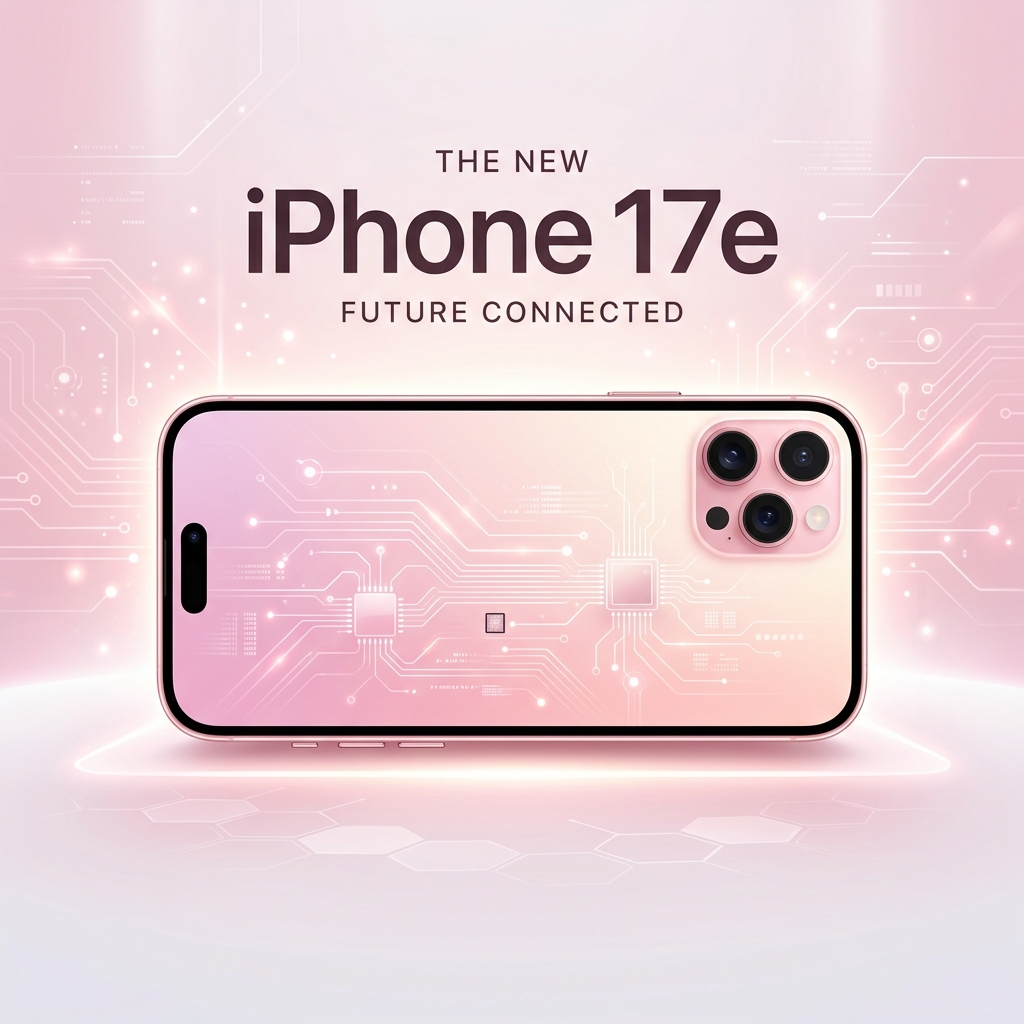
Every year, Apple releases a product specifically designed to make you question whether you actually need the flagship iPhone you've been eyeing. This year, that product is the iPhone 17e—a device that Apple is positioning as the "essential" iPhone, priced at ₹64,900 in India, engineered with a ruthless precision that strips away everything Apple considers non-essential while retaining everything that actually matters. And for the Indian market—the world's second-largest smartphone market by volume, where the average selling price of a smartphone is approximately ₹15,000 and where Apple holds roughly 7-8% unit share (but approximately 25-30% of the premium segment by value)—the iPhone 17e represents Apple's most strategically sophisticated play yet.
The iPhone 17e is not the iPhone SE. Apple has apparently retired the "SE" branding—a designation that carried associations with compromise, with settling for less, with choosing the Apple ecosystem while accepting conspicuously inferior hardware. The "e" in iPhone 17e allegedly stands for "essential"—a branding repositioning that signals a fundamental shift in how Apple conceives its non-flagship models. The SE was a budget iPhone. The iPhone 17e is a carefully engineered subset of the flagship experience, designed to be desirable in its own right rather than a consolation prize for buyers who couldn't afford the Pro.
What You Get for ₹64,900: The Specifications That Matter

The iPhone 17e's specification sheet is a masterclass in strategic compromise—Apple's engineering team deciding, component by component, where to match the flagship and where to diverge, with each decision reflecting a cost-benefit analysis translated into silicon, glass, and aluminium:
Processor—A18 Chip: The iPhone 17e ships with Apple's A18 chip—the same processor that powers the standard iPhone 17. This is the single most important specification decision Apple has made, and it reverses years of SE/budget iPhone tradition where entry-level models shipped with previous-generation processors. The A18's presence means the iPhone 17e will run every app, every game, every AR experience, and every Apple Intelligence feature at identical performance to the standard iPhone 17. It will receive iOS updates for the same duration (historically 5-6 years for iPhones with current-generation processors). It will run generative AI features, on-device language models, and future computational capabilities that require current-generation neural engine hardware. By shipping the current processor rather than a one- or two-generation-old chip, Apple has guaranteed that the iPhone 17e will not feel like a compromise device for the vast majority of its operational lifespan.
Display—6.1" OLED with 60Hz: The display is a genuine OLED panel (not LCD, which all previous iPhone SE models used)—offering the deep blacks, vibrant colours, high contrast ratio, and energy efficiency of OLED technology. The resolution and colour accuracy appear to match the standard iPhone 17. The compromise is the 60Hz refresh rate rather than the 120Hz ProMotion display found on the iPhone 17 Pro. This is the most visible daily-use compromise: scrolling through social media, navigating menus, and reading text will feel perceptibly less smooth on the iPhone 17e than on a Pro model. For users upgrading from any LCD-equipped iPhone (SE, iPhone 11 or earlier), the OLED display itself will feel like a dramatic visual upgrade regardless of the refresh rate. For users accustomed to 120Hz Android phones (which are available at much lower price points), the 60Hz limitation will be noticeable.
Camera—Single 48MP Rear Camera: The iPhone 17e ships with a single rear camera—a 48MP sensor that, based on Apple's historical engineering patterns, likely uses a sensor and lens assembly comparable to the main camera on the standard iPhone 17. The absence of the ultrawide and telephoto lenses found on Pro models is the most significant hardware omission. For the substantial majority of smartphone photography—portraits, food photography, social media content, video calls, document scanning—a single, high-quality camera with Apple's computational photography stack (Smart HDR, Deep Fusion, Photonic Engine) produces results that are indistinguishable from Pro models under most conditions. The limitations emerge in specific use cases: landscape photography benefits from ultrawide; sports and distant subjects benefit from telephoto; professional or serious hobby photographers may find the single-camera constraint genuinely limiting.
Design and Build: The iPhone 17e adopts the iPhone 17 series' updated design language—reportedly the slimmest iPhone body ever produced, with an aluminium and glass construction and the new Camera Control button. The form factor is modern, premium, and visually indistinguishable from the standard iPhone 17 to casual observers. This is a critical market positioning decision: carrying an iPhone 17e does not visually signal "budget model" in the way that the iPhone SE's outdated design with Touch ID button immediately communicated "older/cheaper." The social signaling dimension—important in India's status-conscious smartphone market—shifts from "obviously entry-level" to "indistinguishable from mainstream."
India-Specific Market Strategy: What Apple Is Really Doing
The iPhone 17e's ₹64,900 price point—combined with launch offers, exchange programmes, and EMI options that can reduce the effective cost to ₹45,000-55,000—positions it precisely at the upper boundary of India's fastest-growing smartphone segment: the ₹40,000-70,000 "affordable premium" category. This segment has exploded in India over the past three years, driven by aspirational young professionals, dual-income households, and the normalization of smartphone EMI purchases that transform a ₹65,000 lump sum into a manageable ₹3,000-5,000 monthly payment.
Apple's India strategy has undergone a fundamental transformation since 2020. What was previously a distribution-limited, price-uncompetitive afterthought has become one of Apple's highest-priority growth markets globally. The evidence is unmistakable: Apple opened its first Indian retail stores (Mumbai and Delhi) in 2023—a capital-intensive commitment that Apple reserves for markets it considers strategically permanent. Apple commenced iPhone assembly in India through Foxconn (Tamil Nadu) and Pegatron (Tamil Nadu)—allowing it to avoid the 22% import duty on fully assembled phones and reduce Indian retail prices by 5-10%. Apple launched Apple Intelligence features with Hindi language support—a localization investment that reflects long-term market commitment. The iPhone assembly in India has scaled to approximately 12-14% of global iPhone production, making India Apple's second-largest manufacturing base after China.
The iPhone 17e's competitive landscape in India includes formidable Android alternatives at similar or lower price points. The Samsung Galaxy S25 (approximately ₹65,000) offers a complete flagship specification including 120Hz display, triple camera system, and the latest Snapdragon processor. The OnePlus 13 (approximately ₹60,000) provides 120Hz AMOLED display, 50MP triple camera, and extremely fast charging. The Google Pixel 9 (approximately ₹70,000) offers Google's best-in-class computational photography with the Tensor G4 processor. Against these alternatives, the iPhone 17e's value proposition is not specification superiority—it concedes display refresh rate, camera count, and charging speed to most Android competitors. Its value proposition is ecosystem: iMessage, AirDrop, Apple Watch integration, seamless Mac interoperability, the App Store's curated quality, and the cultural cachet of the Apple brand—intangible advantages that are worth precisely zero to buyers who don't value them and worth the entire purchase price to buyers who do.
The Financial Services Dimension: How India Buys iPhones
Understanding iPhone adoption in India requires understanding how Indians purchase expensive electronics—and the answer is: overwhelmingly on credit. The transformation of smartphone purchasing from a single large transaction to an EMI-financed acquisition has been the most important structural enabler of Apple's Indian market growth. Platforms like Bajaj Finserv, HDFC Bank card EMI, and Flipkart/Amazon no-cost EMI options convert a ₹64,900 iPhone into twelve or eighteen monthly payments of ₹3,600-5,400—a sum that falls within the discretionary spending range of a much larger consumer base than the lump-sum price suggests.
Apple's trade-in and exchange programmes further reduce the effective cost. An iPhone 13 in good condition can command a trade-in value of ₹20,000-28,000, reducing the iPhone 17e's net cost to ₹37,000-45,000. For users in Apple's ecosystem—whose iCloud subscriptions, Apple Watch pairings, AirPods connections, and app purchase libraries create genuine switching costs—upgrading within the iPhone family is economically rational even at price points that appear premium relative to Android alternatives.
Who Should Actually Buy This Phone
The iPhone 17e is precisely right for three specific buyer profiles. First: Android users who want to switch to iOS and have been waiting for an entry point that doesn't feel like a compromise. The iPhone 17e provides a genuinely current-generation Apple experience—current processor, OLED display, modern design—at the lowest price Apple has ever offered for a non-SE, fully modern iPhone. Second: iPhone SE or iPhone 11/12/13 owners looking to upgrade. For these users, the iPhone 17e represents a generational leap in processor performance, display quality, and camera capability at a price point lower than the standard iPhone 17, making it the optimal upgrade path for cost-conscious Apple ecosystem users. Third: Indian consumers in the ₹50,000-70,000 budget range who prioritize software experience, ecosystem integration, long-term software support, and brand consideration over hardware specification maximization. These buyers are not comparing specification sheets; they are choosing between the Apple experience and the Android experience, and for them, the iPhone 17e is Apple's most compelling offer.
Frequently Asked Questions (FAQs)
Is the iPhone 17e worth buying over the standard iPhone 17?
The standard iPhone 17 (expected at approximately ₹79,900 in India) will offer a 120Hz ProMotion display, a dual or triple camera system, and potentially additional features over the 17e. The ₹15,000 price difference buys you: smoother scrolling and animation (120Hz versus 60Hz), additional camera versatility (ultrawide lens at minimum), and potentially more RAM and storage options. If you actively use ultrawide photography, notice refresh rate differences, or want maximum future-proofing, the standard iPhone 17 justifies the premium. If you primarily use your phone for messaging, social media, video consumption, and standard photography, the iPhone 17e provides 90% of the experience at 80% of the price—a value equation that favours the 17e for most Indian consumers.
How does the iPhone 17e compare to Samsung Galaxy S25 for Indian buyers?
The Galaxy S25 (₹64,999 at launch) offers objectively superior hardware specifications: 120Hz Dynamic AMOLED display, triple camera system (50MP main + 12MP ultrawide + 10MP telephoto), Snapdragon 8 Gen 4 processor, and 25W wired + 15W wireless charging. On paper, Samsung wins every specification comparison. The iPhone 17e's advantage is entirely ecosystem-based: if you use a MacBook, AirPods, or Apple Watch, the integration benefits are genuine and irreplaceable. iMessage remains the default messaging platform in certain social circles. iOS app quality and optimization generally exceeds Android equivalents. Apple's long-term software support (5-6 years guaranteed) exceeds Samsung's commitment (4 years). The choice is not primarily about hardware; it is about which software and ecosystem experience you prefer living with daily for the next 3-5 years.
Will Apple Intelligence features work on the iPhone 17e?
Yes. The A18 chip provides full compatibility with Apple Intelligence—Apple's on-device AI framework that includes writing assistance, image generation, notification summarization, enhanced Siri capabilities, and generative AI features integrated across iOS. Apple has confirmed that Apple Intelligence will support Hindi and potentially other Indian languages in forthcoming updates, making these features relevant to the Indian market. The A18 chip's neural engine provides the on-device processing power needed to run AI models locally (without requiring cloud connectivity for many features), which is a significant advantage in India where internet connectivity can be variable. All Apple Intelligence features available on the standard iPhone 17 will be available on the iPhone 17e—there is no tiering of AI functionality based on model tier.

Comments (0)
Be the first to share your thoughts on this article.