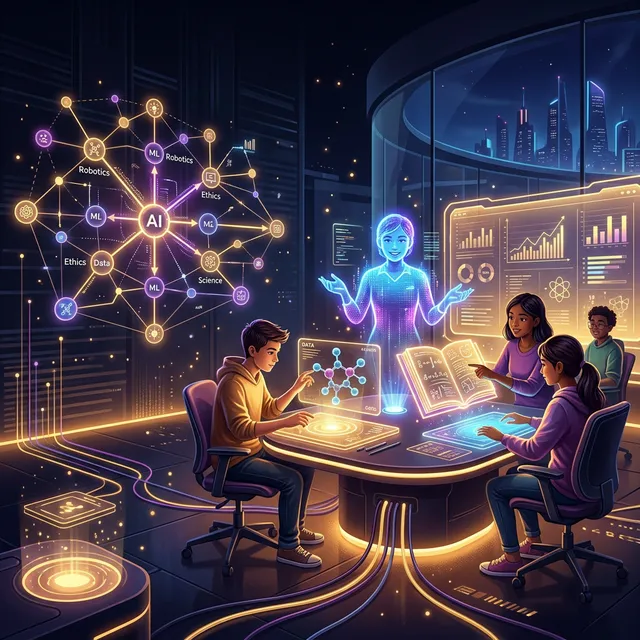
The introduction of artificial intelligence into education is producing a generation of students who will learn differently from every generation before them. This is neither the utopian transformation that EdTech marketers promise—where personalised AI tutors eliminate learning gaps, democratise access to world-class education, and make traditional schools obsolete—nor the dystopian collapse that education traditionalists fear—where students lose the ability to think independently, plagiarism becomes undetectable, and the relationship between teacher and student is reduced to data points. The reality, as observed in classrooms across India, the United States, and Europe over the past two years, is messier, more interesting, and more contingent on implementation quality than either narrative acknowledges.
I have spent the past eighteen months visiting schools and universities that have integrated AI tools into their pedagogy—some enthusiastically, some reluctantly, some disastrously, and a few with genuine thoughtfulness—and the central lesson is that AI in education functions as an amplifier: it makes good teaching more effective and bad teaching worse. A skilled teacher who uses AI as a classroom assistant—generating personalised practice problems, providing immediate feedback on student work, creating differentiated learning materials for students at different proficiency levels—produces learning outcomes that are measurably better than the same teacher working without AI tools. An unskilled teacher who uses AI as a crutch—outsourcing lesson planning, automated grading without review, using AI-generated content without adaptation—produces outcomes that are measurably worse because the AI-generated materials lack the contextual sensitivity and relational awareness that competent teaching requires.
Where AI Actually Works in the Classroom

Personalised Practice and Feedback: The most unambiguously beneficial application of AI in education is the generation of personalised practice materials and immediate feedback. Traditional classroom models provide the same exercises to every student—an approach that bores advanced students and frustrates struggling ones. AI systems can dynamically adjust problem difficulty based on student performance: a student who has mastered two-digit multiplication receives three-digit problems; a student who is struggling receives simplified problems with additional scaffolding (worked examples, visual representations, step-by-step hints). This adaptive practice is not new—it is a computerised version of what excellent tutors have always done—but AI enables it at a scale that makes individual tutoring's benefits available to every student in a class of forty, which is the reality of most Indian classrooms.
The feedback dimension is equally significant. In a traditional classroom, a student who completes a writing assignment receives feedback days or weeks later, when the assignment is returned with handwritten comments. By this time, the student's working memory of the writing process has faded, and the feedback's value for improving future performance is diminished. AI writing assistants can provide real-time feedback on grammar, structure, argument coherence, and evidence use as the student writes—not replacing the teacher's evaluative judgment but providing a continuous feedback loop that helps students self-correct during the writing process rather than after it. The pedagogical principle is well-established: feedback is most effective when delivered immediately, specifically, and with clear guidance for improvement. AI can deliver feedback with immediacy and specificity that teachers, managing thirty-plus students simultaneously, structurally cannot.
Language Learning Acceleration: Language education is the domain where AI produces the most dramatic, most measurable improvement over traditional methods. The fundamental bottleneck in language learning is practice—specifically, conversational practice with a responsive interlocutor who provides corrections and adaptations in real time. In traditional classroom language learning, each student gets a few minutes of speaking practice per class session. AI conversational partners (available through apps like Duolingo Max, Speak, and native ChatGPT voice mode) provide unlimited, on-demand conversational practice with infinite patience, adjustable difficulty, and the ability to conduct conversations in any topic domain the student chooses. Students using AI conversational practice for 20-30 minutes daily alongside classroom instruction consistently demonstrate faster vocabulary acquisition, better pronunciation (AI can detect and correct specific phonemic errors in real time), and greater conversational confidence than students relying solely on classroom practice.
The Plagiarism Problem: Worse and Better Than You Think
The arrival of large language models in education created a crisis that the education system is still processing: students can now generate plausible, well-structured, grammatically correct essays, homework solutions, and even code assignments using AI, and the resulting work is increasingly difficult to distinguish from student-produced work using conventional plagiarism detection tools. AI detection tools (Turnitin's AI detection, GPTZero, Originality.ai) exist but are unreliable—they produce significant false positive rates (incorrectly flagging genuine student writing as AI-generated, particularly for non-native English speakers whose writing patterns may trigger detection heuristics) and false negative rates (failing to detect AI-generated text that has been lightly edited or paraphrased by the student).
The crisis is real but the solution is not primarily technological. The most effective response, observed in institutions that have adapted successfully, involves three complementary strategies: redesigning assessments to resist AI completion (emphasising oral presentations, in-class writing, portfolio-based assessment that tracks the evolution of a student's thinking, and project-based learning that requires physical demonstrations or community engagement); teaching students to use AI as a legitimate learning tool rather than a cheating mechanism (assigning work that explicitly incorporates AI—"use Claude to generate an initial analysis, then critique the analysis and improve it using course concepts"); and having honest conversations about the purpose of learning in an AI-capable world (why learning to write matters even when AI can produce competent prose, why understanding mathematical proofs matters even when AI can solve problems, why developing domain expertise matters even when AI can provide surface-level answers on any topic).
What Should Not Change: The Teacher-Student Relationship
The most important finding from two years of observing AI-integrated classrooms is negative: the most critical component of effective education—the relationship between teacher and student—is not improved by AI and should not be outsourced to it. Learning is fundamentally a social, emotional, and relational process. Students learn from teachers they trust, respect, and feel seen by. The motivational, emotional, and developmental functions of teaching—noticing that a student is struggling emotionally before they are struggling academically, motivating a disengaged student through personal connection, modelling curiosity and intellectual integrity through example, creating classroom cultures where mistakes are learning opportunities rather than failures—are capabilities that AI does not possess and that no amount of natural language processing will replicate.
The schools that have integrated AI most successfully are the ones that have most explicitly protected the relational core of teaching while automating the administrative and repetitive tasks that consume teachers' time and energy without contributing to the relational mission. AI handles: generating practice problems, grading multiple-choice assessments, providing first-pass feedback on writing mechanics, creating differentiated materials, and managing administrative record-keeping. Teachers handle: understanding individual students' emotional and developmental needs, facilitating discussion and debate, providing evaluative feedback that connects academic performance to personal growth, and creating the sense of safety, belonging, and intellectual community that makes learning possible. This division of labour—AI for efficiency, humans for connection—is not merely a pragmatic compromise. It is an accurate reflection of what each is actually good at.
The Indian Classroom Context
India's education system presents specific challenges and opportunities for AI integration that differ significantly from Western contexts. The teacher-student ratio in most Indian government schools (often 1:40 or 1:50, sometimes exceeding 1:60) makes individualised attention a physical impossibility for even the most dedicated teacher. AI-powered personalised learning tools have the potential to provide differentiated instruction that Indian classrooms cannot deliver through human teaching alone. However, the infrastructure requirements—reliable internet connectivity, sufficient devices per student, electricity for charging—remain significant barriers in rural and semi-urban Indian schools. The most successful Indian EdTech deployments have been those that function offline or with minimal connectivity—apps that download content during periodic connectivity windows and function independently thereafter.
India's linguistic diversity creates an additional dimension: effective AI educational tools must function in Hindi, Tamil, Telugu, Bengali, Marathi, and regional languages, not merely in English. The development of multilingual AI educational content is lagging significantly behind English-language offerings, creating a digital divide within AI education itself—students who can learn in English have access to dramatically more AI educational resources than students learning in vernacular languages.
Frequently Asked Questions (FAQs)
Should schools ban AI tools like ChatGPT?
Banning AI tools in educational settings is counterproductive for the same reason that banning calculators in mathematics education would have been counterproductive in the 1990s: the tools exist, students will use them outside school regardless, and the educational mission should be to teach effective and ethical use rather than to pretend the technology doesn't exist. The schools that have banned AI are discovering that enforcement is impossible and that the ban merely drives AI use underground, eliminating the opportunity for guided, pedagogically sound integration. The better approach is to redesign curriculum and assessment to incorporate AI as a legitimate tool, teach critical evaluation of AI outputs, and create clear academic integrity policies that distinguish between acceptable AI use (research assistance, feedback on drafts, brainstorming) and unacceptable AI use (submitting AI-generated work as one's own without substantial original contribution).
Will AI tutors replace human teachers?
AI tutors will replace certain teaching functions—particularly the delivery of factual content and the provision of practice exercises—but they will not replace teachers. The distinction is between instruction (transferring information and developing skills) and education (developing the whole person—intellectually, socially, emotionally, and ethically). AI is increasingly capable of instruction. Education remains a fundamentally human endeavour that requires the relational, emotional, and moral capabilities that AI does not possess. A more accurate prediction is that the teacher's role will evolve from "primary information source" to "learning facilitator, mentor, and evaluator"—a role that is more demanding, more skilled, and more valuable than the traditional lecturing role, and one that AI makes possible by handling the routine instructional tasks that previously consumed the majority of teachers' time.
How should parents approach their children's use of AI for schoolwork?
The most effective parental approach mirrors the most effective institutional approach: guide rather than prohibit. Help your child understand the difference between using AI to learn (asking Claude to explain a concept in different ways until understanding is achieved, using AI to check their work and understand errors, using AI to brainstorm ideas that they then develop independently) and using AI to avoid learning (having AI complete their assignment, copying AI-generated text, and submitting it as their own work). Establish clear household norms: AI is a learning partner, not a homework-completion service. The learning is the point; the completed assignment is merely evidence of learning. If AI completes the assignment, the evidence is fraudulent regardless of the grade it receives, and the learning has not occurred regardless of how polished the submission appears.



Comments (0)
Be the first to share your thoughts on this article.