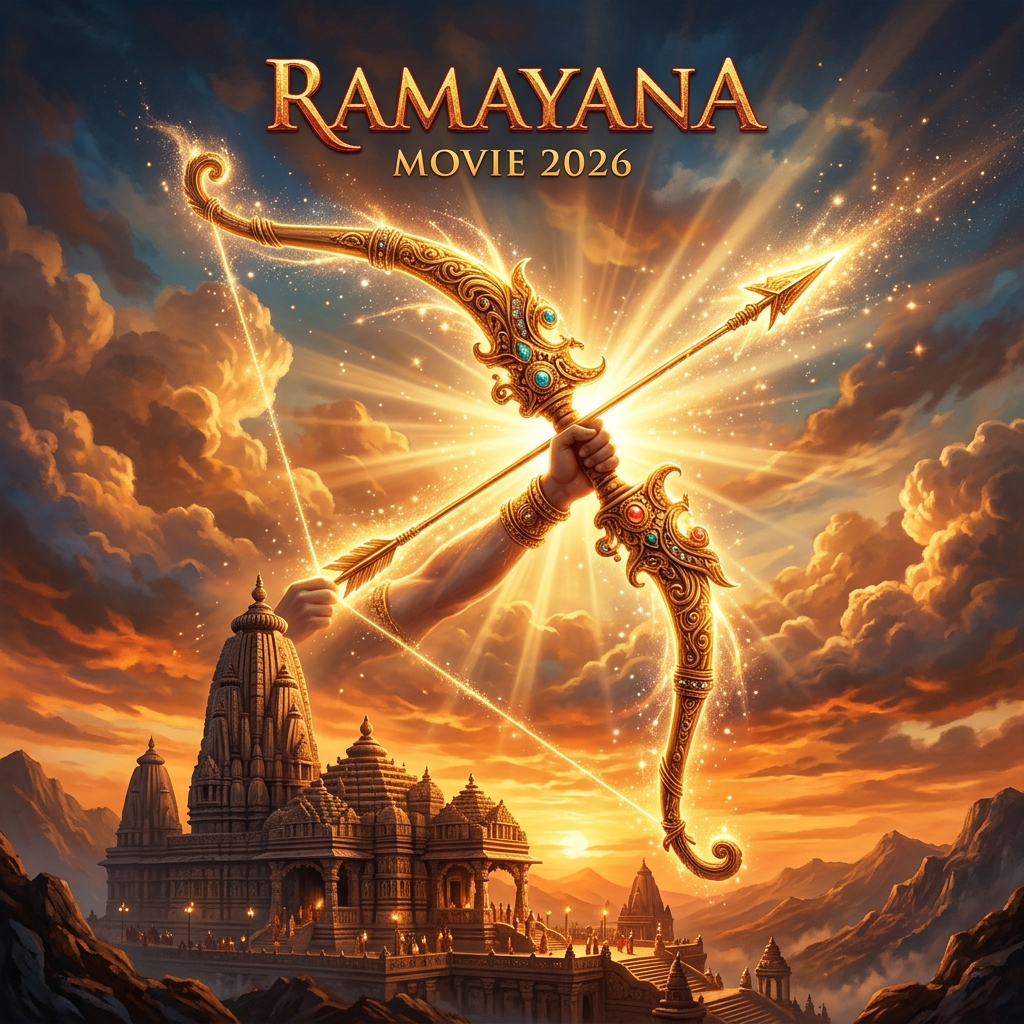
Two minutes and thirty-eight seconds. That's all we got on April 2nd, 2026. But those 158 seconds might break the internet harder than anything the Indian entertainment industry has produced in decades. The Ramayana movie teaser—from director Nitesh Tiwari, produced by an unprecedented alliance of T-Series, Prime Focus, and the combined financial muscle of Indian cinema's most ambitious production collaboration—is not merely a film trailer. It is the first visual evidence that India's film industry is genuinely, seriously, technologically attempting to create a cinematic experience that competes with—and potentially surpasses—the visual scale of Hollywood's biggest mythological and fantasy epics. And the stakes, both cultural and commercial, are absolutely enormous.
The Ramayana has been adapted for Indian screens before—most iconically by Ramanand Sagar, whose 1987-88 Doordarshan television series achieved viewership numbers so extraordinary that they have become a permanent fixture of Indian cultural mythology themselves: Sunday mornings when streets emptied, cities fell silent, and an estimated 650 million viewers (in a country of 800 million) gathered around television sets to watch Ram, Sita, and Laxman navigate the epic's familiar narrative. That serialized television adaptation, with its deliberately paced storytelling, painted studio backdrops, and special effects that now look charmingly primitive, was not diminished by its technical limitations—it was elevated by the collective emotional investment of a nation watching together, week after week, for 78 episodes. It remains the most-watched television broadcast in Indian history, and its cultural gravity shaped the religious and political consciousness of an entire generation.
What the Teaser Reveals: Scale Beyond Precedent

The teaser, though brief, reveals enough visual information to establish several critical facts about the production's ambition and execution:
Visual Effects Scale: The VFX work visible in the teaser represents a quantum leap for Indian cinema. The creation of Lanka—Ravana's golden island fortress—appears to involve full computer-generated environment construction at a scale and fidelity that Indian VFX studios have never previously attempted for a domestic production. The architectural visualization draws from temple architecture across South and Southeast Asia—Angkor Wat's towering gopuras, Hampi's boulder-strewn grandeur, Thanjavur's Brihadisvara temple geometry—synthesized into a fantasy civilization that feels simultaneously mythological and physically plausible. The forest sequences—Dandakaranya, the wilderness of Ram's exile—show environmental rendering with a depth, density, and atmospheric complexity (volumetric lighting through forest canopies, particle effects for dust and pollen, water simulation for river crossings) that would not be out of place in a Weta Digital or Industrial Light & Magic showcase reel.
The creature design, glimpsed briefly in the teaser's climactic montage, suggests that the production has committed to creating the Vanara (monkey warrior) army and Ravana's Rakshasa forces not as costumed actors with prosthetics (the approach used by most Indian mythological productions) but as fully realized digital characters rendered with motion-capture performance and photorealistic texturing. This is the technical approach that produced Gollum in Lord of the Rings, Caesar in Planet of the Apes, and Thanos in Avengers—a pipeline that requires specialized performance capture stages, sophisticated facial animation rigs, and rendering capabilities that consume thousands of GPU-hours per minute of final footage. If the finished film achieves the quality suggested by the teaser, it would represent the first Indian production to successfully execute digital character creation at Hollywood's current technical standard.
Casting and Performance: Ranbir Kapoor as Ram, Sai Pallavi as Sita, and Yash as Ravana—a casting trio that represents the production's strategic ambition to bridge Indian cinema's regional and linguistic audiences. Ranbir Kapoor carries the Hindi film industry's most nuanced dramatic acting pedigree (Barfi!, Rockstar, Ae Dil Hai Mushkil, Animal). Sai Pallavi brings an authenticity and emotional directness cultivated through Telugu, Tamil, and Malayalam cinema that resonates with South Indian audiences in a way that purely Bollywood-centric casting would not. Yash—whose KGF franchise demonstrated his capacity for the physical intensity and larger-than-life screen presence that Ravana demands—provides the antagonist gravitas that transforms a mythological villain from a narrative device into a compelling character. The casting is pan-Indian by design, reflecting the film's ambition to be not a "Bollywood movie" or a "Hindi movie" but an Indian cinematic event that belongs equally to every linguistic and regional audience.
The Production Economics: India's Most Expensive Film
Ramayana is reportedly the most expensive Indian film ever produced, with budget estimates ranging from ₹800 crore to ₹1,100 crore across its two planned parts. To contextualize this figure: the most expensive Indian film previously released—Baahubali: The Conclusion—cost approximately ₹250 crore. The Ramayana budget represents a 3-4x escalation in production spending, reflecting the dramatically higher cost of Hollywood-comparable VFX work, the multi-year production schedule (principal photography has spanned over two years), the star cast compensation, and the construction of elaborate practical sets that are then extended and enhanced through visual effects.
The commercial mathematics of recovering a ₹1,000+ crore production investment through theatrical revenue alone are daunting. Indian domestic box office records are held by films that earned ₹500-700 crore in net domestic theatrical revenue—meaning Ramayana would need to significantly exceed every existing Indian box office record simply to break even on production costs, before accounting for prints and advertising expenditure (typically 30-50% of production cost for a release of this scale). The business model that makes the production financially viable relies on a revenue stack that extends far beyond domestic theatrical: global theatrical release across 50+ countries, satellite television rights (valued at ₹200-300 crore for a film of this magnitude), digital streaming rights (potentially ₹300-500 crore for a premium title), music rights, merchandising, and potential theme park and experiential entertainment licensing.
The two-part release strategy—with Part 1 targeting a late 2026 or early 2027 release and Part 2 following 12-18 months later—is both a creative choice (the Ramayana's narrative scope genuinely warrants multi-film treatment) and a financial risk mitigation strategy. If Part 1 performs well theatrically, it validates the audience demand and creates anticipation-driven marketing for Part 2 at negligible additional marketing cost. If Part 1 underperforms, the production can potentially recalibrate Part 2's scope and release strategy to manage losses. The Lord of the Rings trilogy and the Baahubali duology both demonstrated that multi-part cinematic epics can generate cumulative revenue substantially greater than the sum of hypothetical individual releases—but both also demonstrated the risk of front-loading production investment on a franchise whose audience reception is uncertain.
Cultural Weight: Why This Film Matters Beyond Entertainment
The Ramayana occupies a unique position in Indian culture that makes its cinematic adaptation qualitatively different from any other film production. It is not merely a "story" being "adapted"—it is a foundational cultural text that has shaped Indian civilization's moral imagination, religious practice, social norms, artistic tradition, and philosophical discourse for over two millennia. The Ramayana exists in hundreds of versions across dozens of languages—Valmiki's Sanskrit original, Tulsidas's Awadhi Ramcharitmanas, Kamban's Tamil Ramavataram, and countless regional, folk, and contemporary reinterpretations. Every Indian, regardless of religious affiliation, geographic origin, or linguistic background, carries an internalized Ramayana narrative that forms part of their cultural DNA.
This cultural centrality creates both extraordinary opportunity and extraordinary risk for the filmmakers. The opportunity is a built-in audience of potentially billions across the Indian subcontinent and the global Indian diaspora who have an emotional, devotional, and cultural relationship with the source material that no original screenplay could replicate. The risk is that the same emotional intensity that drives audience interest also drives critical scrutiny: every creative choice—casting, costume design, dialogue, narrative emphasis, the physical appearance of sacred characters—will be evaluated not merely as artistic decisions but as statements about religious interpretation, cultural authenticity, and devotional respect. The Ram Mandir consecration in Ayodhya in January 2024 has intensified the cultural charged-ness of any Ramayana-related media production, embedding it in a political and religious context that transcends entertainment.
Director Nitesh Tiwari's previous work—Dangal (India's highest-grossing domestic film at the time of its release), Chhichhore—demonstrates a capacity for emotionally resonant storytelling grounded in authentic cultural specificity. The question is whether this sensibility—developed in realistic, contemporary settings—can translate to the mythological register, where the narrative constraints include divine intervention, supernatural combat, and characters who are simultaneously human and divine. The visual language of the teaser suggests that Tiwari's approach is to ground the mythological in physical reality—creating environments and characters that feel tangible, weighted, and architecturally plausible rather than the stylized, overtly fantastical aesthetic that Indian mythological productions have traditionally employed.
The Indian VFX Industry's Defining Moment
The Ramayana production represents a potential inflection point for India's visual effects industry. India already has a substantial VFX services industry—companies like Prime Focus (which is also a producer on Ramayana), DNEG India, Technicolor India, and several specialized studios provide VFX services for Hollywood productions, contributing to films including The Batman, Dune, Avatar: The Way of Water, and numerous Marvel Cinematic Universe titles. However, this work has predominantly been outsourced services—Indian VFX artists executing shots designed and supervised by Hollywood-based VFX supervisors within Hollywood production pipelines. The creative leadership, technical specification, and artistic direction have historically resided with Western studios.
Ramayana inverts this hierarchy for the first time at this scale. Indian VFX studios and supervisors are leading the creative vision, technical pipeline, and artistic direction for VFX work of Hollywood-comparable scope and complexity. If the executed quality matches the teaser's promise, it demonstrates that Indian VFX capability has matured from outsourced execution to indigenous creative leadership—a transition with enormous implications for the global VFX industry's geographic distribution and for India's position within it.
Frequently Asked Questions (FAQs)
When will the Ramayana movie be released?
The current target is Diwali 2026 (late October/November 2026) for Part 1, though official release dates have not been formally confirmed by the production team. Given the VFX-intensive post-production schedule and the producers' stated intent to achieve visual quality benchmarks before committing to a release date, a delay to early 2027 (Republic Day or Holi window) is entirely possible. Part 2 is expected 12-18 months after Part 1's release. The production's approach has been explicitly quality-over-schedule, reflecting the understanding that a visually compromised release would be commercially and culturally catastrophic regardless of the release timing.
Is this related to the Ramanand Sagar TV Ramayan?
No. This is an entirely independent production with no narrative, creative, or licensing connection to Ramanand Sagar's 1987-88 Doordarshan television serial or its later remakes. The literary source material—the Ramayana epic—is public domain and has been for millennia; there is no intellectual property restriction on adapting it. However, the cultural memory of Ramanand Sagar's serialized Ramayan is so deeply embedded in Indian consciousness that every new Ramayana adaptation inevitably exists in relationship to it, regardless of formal connection. Viewers will compare Ranbir Kapoor's Ram to Arun Govil's Ram, Sai Pallavi's Sita to Dipika Chikhlia's Sita—comparisons that are culturally inevitable and that the filmmakers must navigate knowing that nostalgia is a formidable competitor.
Will the film be released in multiple languages?
Yes. Given the pan-Indian casting strategy and the universal cultural resonance of the Ramayana across linguistic regions, the film is planned for simultaneous release in Hindi, Tamil, Telugu, Kannada, and Malayalam—the five major language markets that collectively constitute over 90% of Indian theatrical revenue. The production has reportedly invested in high-quality dubbing and localization rather than the often-criticized post-production dubbing that Hindi films have historically used for South Indian market releases. The involvement of Sai Pallavi (a pan-South Indian star) and Yash (a Kannada-origin star with pan-Indian recognition through KGF) is specifically designed to make the film's marketing viable across all major markets without the "dubbed Hindi film" stigma that has historically limited North Indian productions' South Indian penetration.


Comments (0)
Be the first to share your thoughts on this article.