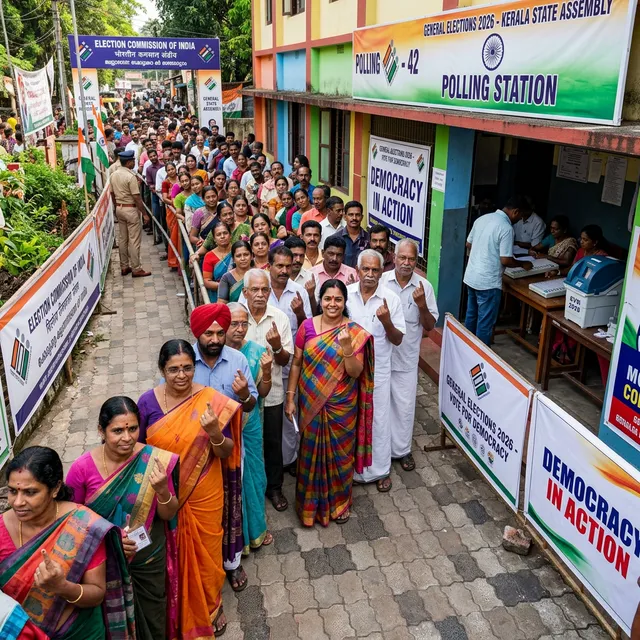
Indian elections are not events. They are seasons—extended, all-consuming, operationally extraordinary democratic spectacles that mobilize hundreds of millions of citizens across landscapes of such geographical, linguistic, cultural, and socioeconomic diversity that the logistical achievement of conducting them fairly would be considered impossible if India had not been doing it, routinely and successfully, for seven decades. Preparation begins months before the first ballot is cast. Campaign rhetoric builds in orchestrated waves. Coalition mathematics—the deeply complex, game-theoretic calculations of which parties will ally with which other parties in which specific constituencies—shift on a near-daily basis. And the outcomes, regardless of which party wins, reshape the policy direction of states where populations exceed those of many independent nations.
The 2026 state assembly elections continue this extraordinary democratic tradition with their own specific contexts, stakes, and narratives. To understand why these elections matter requires understanding something that international observers frequently miss about Indian democracy: state elections are not subsidiary events. They are, in many ways, more immediately consequential for the daily lives of ordinary citizens than national general elections, because India's federal structure concentrates the governance functions that most directly affect daily life—education, healthcare, law enforcement, land policy, local taxation, water supply, urban governance—at the state level.
Why State Elections Matter More Than You Think

India's constitutional architecture creates a genuinely, functionally federal system in which state governments possess autonomous control over policy domains that define the quality of daily life for their citizens. When you interact with a government school, a public hospital, a police station, a land registry office, a municipal water supply system, or a local road—you are interacting with a state government function, not a central government function. A change in the party controlling a state government can, and routinely does, produce immediate, visible changes in these domains: different policing priorities, different educational emphases, different healthcare spending patterns, different infrastructure investment strategies, different welfare scheme designs.
State elections also function as a continuous, rolling referendum on the national government's performance between general elections. Indian general elections occur every five years, but state assembly elections are held in staggered cycles across different states throughout the five-year period. Each state election result is intensely scrutinized—by the ruling party, the opposition, the media, and international observers—for signals about the national political mood. A governing party that loses multiple state elections faces internal pressure, narrative challenges, and practical governance consequences: the composition of the Rajya Sabha (the upper house of India's Parliament) is determined by state legislative assemblies, meaning state election losses can directly weaken a national government's legislative agenda.
Coalition dynamics in Indian politics add another layer of consequence. India's multi-party system means that state-level alliances between national and regional parties often determine national political trajectories. A regional party that wins or loses a state election can become or cease to be a critical coalition partner at the national level, potentially altering the stability and policy direction of the central government itself.
The Key Themes Shaping 2026 State Contests
Economic Performance Versus Welfare Distribution: Every Indian state election is, at its foundation, a negotiation between two complementary but politically competitive priorities: economic growth (measured through GDP expansion, industrial investment, job creation, and infrastructure development) and social welfare (measured through the reach and generosity of subsidized food schemes, housing programs, healthcare access, and direct benefit transfers). The parties and chief ministerial candidates who most effectively communicate competence on both dimensions—demonstrating that they can attract investment while simultaneously ensuring that growth benefits reach the economically vulnerable—consistently outperform those who emphasize growth without distribution or welfare without economic sustainability.
The 2026 cycle features an intensified version of this negotiation because of India's post-pandemic economic recovery pattern: national GDP has recovered to pre-pandemic growth rates, but employment generation—particularly in the formal sector—has lagged behind headline economic numbers. State governments face an electorate that simultaneously appreciates macro-economic stability and is frustrated by the micro-economic reality of limited job opportunities for educated young people. The state that most effectively addresses the youth employment challenge—whether through direct government job creation, private sector incentive programs, or skill development initiatives—will generate a governance template that national parties will study and replicate.
Caste and Community Dynamics—The Architecture of Representation: Indian electoral politics operates within a social architecture that international observers frequently misunderstand. Caste and community identity are not "distortions" of Indian democracy; they are constitutive features of a society in which historical social stratification has created distinct communities with specific, legitimate claims on political representation and resource distribution. Ticket distribution—the strategically critical process by which parties select candidates for specific constituencies—is determined as much by caste arithmetic (ensuring the candidate belongs to the dominant community in the constituency) as by individual merit, precisely because voters in many constituencies vote as communities for communal representation as much as for individual candidates.
The sophistication of caste calculus in Indian election strategy is extraordinary. Parties maintain detailed caste-composition databases for every constituency. Coalition partners are selected partly to complement caste coverage—a party dominant among Yadavs might ally with a party dominant among Jatavs to create a combined caste coalition that constitutes a majority. Sub-caste, religious community, and regional identity further subdivide the electorate into dozens of micro-segments, each with specific demands, historical grievances, and transactional expectations. Managing this complexity—without alienating any critical segment—is arguably the most demanding strategic challenge in democratic politics anywhere on Earth.
Anti-Incumbency and the "Change" Impulse: Indian voters have historically demonstrated a powerful tendency to punish incumbent state governments, particularly those perceived as having failed to deliver on campaign promises, allowed corruption to flourish, or simply exhausted their administrative energy. This "anti-incumbency factor" is one of the most consistent patterns in Indian electoral behaviour—state governments that have completed two or three consecutive terms face an increasingly steep electoral headwind regardless of their actual policy record, because the accumulated frustrations of governance (unfulfilled expectations, unresolved local issues, institutional fatigue) create a generalized appetite for change.
However, anti-incumbency is not an absolute rule. Well-performing incumbents with strong personal brands, visible service delivery improvements, and effective communication of their achievements have won re-election and even expanded their margins. The key variable is not incumbency per se but the gap between pre-election promises and post-election delivery. Governments that under-promise and over-deliver tend to survive anti-incumbency; those that over-promise and under-deliver face its full electoral force.
Digital Campaigning and Information Warfare: The 2026 state elections represent the most digitally intensive electoral contests in Indian history. Social media platforms (WhatsApp, YouTube, Instagram, X/Twitter), digital advertising, data-driven micro-targeting of voter segments, and AI-generated content have become central strategic instruments in every major party's campaign toolkit. The parties with the most sophisticated digital operations—those capable of producing rapid-response content, identifying persuadable voter segments through data analytics, and maintaining sustained, coordinated messaging across multiple platforms simultaneously—possess structural campaign advantages that traditional rally-based politics alone cannot match.
The darker dimension of digital campaigning—misinformation, deepfake videos that fabricate candidate speeches, coordinated inauthentic messaging that simulates grassroots sentiment, and communally inflammatory content designed to polarize the electorate—represents a genuine, escalating threat to electoral integrity. The Election Commission of India has implemented digital monitoring cells and social media content guidelines, but the speed and volume of digital content production overwhelms institutional moderation capacity. The information environment in which Indian voters form electoral judgments is increasingly shaped by content whose authenticity, provenance, and intent they cannot independently verify.
Indian Democracy's Extraordinary Operational Achievement
Whatever the specific outcomes of the 2026 state elections, the operational achievement of conducting them deserves explicit recognition. Indian state elections routinely mobilize 60-80% of eligible voters—turnout rates that exceed most Western democracies. The Election Commission of India deploys hundreds of thousands of election officials, security personnel, and electronic voting machines across constituencies that include remote Himalayan villages accessible only by foot, island territories reachable only by boat, and dense urban wards where polling stations serve thousands of voters in single rooms. The Commission enforces a Model Code of Conduct that regulates campaign spending, prohibits voter inducements, and mandates equal media access—imperfectly, but with an institutional seriousness that commands international respect.
The fundamental democratic mechanism—citizens choosing their government through free, secret balloting, with peaceful transfer of power to the winning party—functions with remarkable robustness in a society of extraordinary diversity and complexity. This is not guaranteed. It is not automatic. It is the product of institutional integrity, judicial oversight, and a deep, culturally embedded civic commitment to democratic participation that Indians often undervalue precisely because they have never known its absence.
Frequently Asked Questions (FAQs)
How does India's Election Commission manage elections of such enormous scale?
The Election Commission of India is one of the most operationally impressive democratic institutions in the world. For a typical state assembly election covering 200-400 constituencies with 50-100 million eligible voters, the Commission deploys 300,000-500,000 poll workers, 200,000-400,000 security personnel, and lakhs of Electronic Voting Machines (EVMs) with Voter Verifiable Paper Audit Trail (VVPAT) units. Logistics planning begins 6-8 months before the election date. Every polling station—including those in extreme geographic locations—must receive EVMs, security personnel, and essential supplies on precisely the right day. The entire operation runs on a meticulously documented standard operating procedure that has been refined through decades of experience.
Why do Indian state elections often produce different results from national elections in the same state?
Because voters evaluate state and national governments on different criteria. A voter might support Party A at the national level (for foreign policy, defence, or national economic management) while supporting Party B at the state level (for local governance quality, welfare schemes, or caste representation). Indian voters are strategically sophisticated—they understand that state and national governments control different policy domains and vote accordingly. Additionally, local candidate strength, regional party presence, and state-specific issues (water disputes, agricultural distress, industrial development) influence state elections in ways that have no parallel in national contests.
Is money power really a significant factor in Indian elections?
Yes, unambiguously. Despite the Election Commission's spending limits (approximately ₹28-40 lakh per candidate, depending on the state), actual campaign spending routinely exceeds these limits by orders of magnitude. Political parties and candidates fund rallies, transportation, promotional materials, media campaigns, and—in many cases—direct voter inducements (cash, liquor, household goods distributed before polling day) through unofficial channels. The Association for Democratic Reforms (ADR) estimates that actual candidate spending in competitive constituencies can reach ₹10-50 crore—far exceeding legal limits. This creates an entry barrier that effectively excludes candidates without access to significant financial resources, regardless of their policy credentials or electoral support.



Comments (0)
Be the first to share your thoughts on this article.