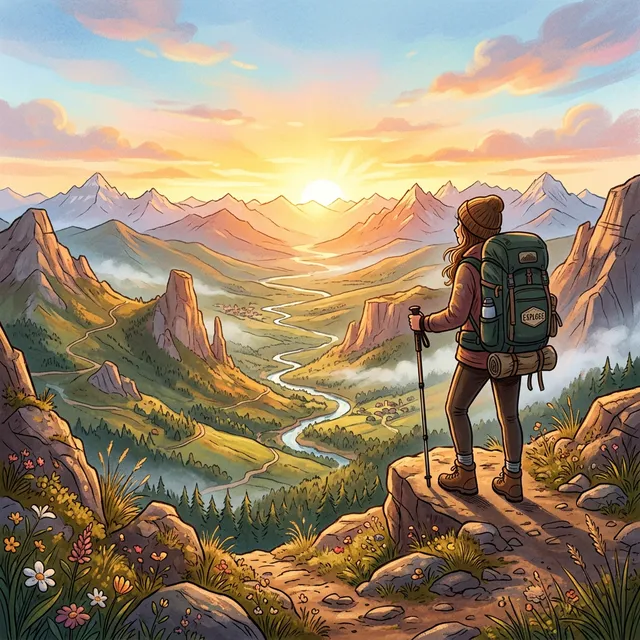
Nobody told me that solo travel would be boring. They told me it would be terrifying ("you're going ALONE?"), transformative ("you'll find yourself"), empowering ("you're so brave"), and occasionally dangerous ("carry pepper spray"). Nobody mentioned that the dominant experience of traveling alone—particularly the first time—is not terror or enlightenment but a specific, uncomfortable, surprisingly productive species of boredom that arises when you remove the social infrastructure that normally occupies 60-70% of your waking attention and are left, for the first time in possibly years, with nothing but your own thoughts for company.
I took my first solo trip in October 2023: a nine-day circuit of Rajasthan—Jaipur, Jodhpur, Jaisalmer—that I planned obsessively, packed for neurotically, and began with the calm confidence of someone who had watched approximately eleven "solo travel India" YouTube videos and therefore considered themselves adequately prepared. I was incorrect about virtually everything I had anticipated: the parts I expected to be difficult (navigating unfamiliar cities, eating alone in restaurants, sleeping in rooms where I was the only occupant) turned out to be trivially easy, while the parts I hadn't anticipated at all (the crushing weight of unstructured time, the self-consciousness of being observed by locals as an obvious tourist, the unexpected emotional intensity of experiencing beauty without anyone to share it with) turned out to be the actual challenges—and, eventually, the actual rewards—of the experience.
The First 72 Hours: What Nobody Prepares You For

The opening phase of solo travel—the first two to three days—is characterised by a specific emotional pattern that every solo traveler I have spoken with has recognised but that travel content systematically omits because it is not photogenic and does not generate engagement. The pattern is: excitement (the first few hours, fuelled by novelty and adrenaline), self-consciousness (day one into day two, as the fact of being alone in an unfamiliar place becomes fully real), loneliness (peaking somewhere in the middle of day two), and then—if you resist the urge to distract yourself with your phone, cut the trip short, or desperately attach yourself to the first group of travelers you encounter—a gradual, quiet opening into a mode of attention that is qualitatively different from anything available in social travel.
This mode of attention is difficult to describe without sounding precious, but it is real and it is valuable: when you are alone, you see more. Not because your eyes work differently, but because the cognitive resources normally allocated to conversation, social monitoring, and interpersonal negotiation ("where should we eat?", "are you tired?", "should we go left or right?") are freed for observation. You notice the colour of light changing on sandstone. You notice the specific sound that wind makes through the carved jharokha windows of a Rajputhan haveli. You notice the facial expressions of strangers in a way that is invasive in social travel (where your attention belongs to your companion) and natural in solo travel (where your attention belongs to the environment). The observation is not philosophical; it is practical. You see the city better because you have nothing else to look at.
Practical Realities of Solo Travel in India
India as a solo travel destination is simultaneously one of the most rewarding and most challenging options available. The rewards are obvious: extraordinary cultural density, genuinely warm hospitality toward visitors, food that ranges from exceptional to life-altering, accommodation at every price point from ₹300 dormitory beds to ₹30,000 heritage hotel suites, and the sheer sensory intensity of a country that refuses to be experienced passively—India demands your attention in a way that quieter destinations do not. The challenges are equally real but more manageable than the fear industry suggests.
Transportation: India's rail network is the solo traveler's greatest practical advantage. The Indian Railways booking system (IRCTC) allows you to book tickets on your phone, travel in classes ranging from the social chaos of General (unreserved) to the comfortable privacy of AC First Class, and reach virtually any destination in the country. Train travel in India is safer than road travel (which is genuinely dangerous) and more interesting than air travel (which is efficient but experientially sterile). For solo travelers, trains provide a natural social environment: in Sleeper and AC 3-Tier classes, you share a compartment with other passengers, and conversations happen naturally—Indians are, as a culture, curious about travelers and generous with conversation, food sharing, and unsolicited but often useful advice. These train conversations have consistently been among the most memorable experiences of my solo travels.
Accommodation: The accommodation landscape for solo travelers has been transformed by hostels—Zostel, Backpacker Panda, GoStops, and numerous independent hostels in tourist destinations—which provide private rooms or dormitory beds at ₹400-1,500 per night, communal spaces designed for social interaction (critical for solo travelers who want occasional company), and the implicit social permission of a hostel environment (where being alone is normal, unlike a hotel where being alone can feel isolating). For solo travelers who prefer more privacy, budget hotels and guesthouses (₹800-2,000 per night in most Indian cities) provide private rooms, and apps like OYO, MakeMyTrip, and Booking.com allow pre-booking with verified photos and reviews that eliminate the anxiety of arriving at an unknown accommodation.
Food: Eating alone in India is not the anxiety-producing experience that it can be in Western countries, because Indian food culture accommodates individual dining naturally. Street food—which is some of India's best food—is inherently solo-friendly (you stand at a counter, eat, and leave). Restaurant meals for one person are normal in Indian dhabas and casual restaurants—nobody questions why you're alone, nobody gives you the small table near the bathroom. In finer restaurants, eating alone may attract mild curiosity but no judgment. The specific advantage of eating solo is dietary freedom: you eat exactly what you want, when you want it, at the pace you want—a freedom that is trivially simple and surprisingly liberating when you have spent years negotiating meal choices with companions.
What Solo Travel Actually Changes About You
The "you'll find yourself" cliché of solo travel is both overblown and directionally correct. You do not find some essential, hidden version of yourself that was waiting in the desert outside Jaisalmer. What you find is your own decision-making in its purest form: stripped of social influence, freed from the comfortable outsourcing of choices to companions, you discover what you actually want to do when nobody else's preferences are in the equation. This discovery is mundane but revealing: you learn that you prefer waking early to sleeping in, or vice versa. You learn that you prefer spending three hours in a museum to spending thirty minutes. You learn that you enjoy talking to strangers or that you despise it. These discoveries—which sound trivially obvious but which years of social accommodation may have obscured—constitute a practical self-knowledge that is genuinely useful in subsequent life decisions.
The confidence effect is less mystical and more practical than travel literature suggests: having navigated an unfamiliar city alone, solved logistical problems without assistance, and managed your own emotional states (loneliness, anxiety, boredom) through your own resources, you develop a specific, evidence-based confidence in your ability to handle unfamiliar situations. This confidence is not bravado; it is the legitimate outcome of having done something that was uncomfortable and discovered that you could do it. It transfers directly to professional and personal contexts: the person who has eaten alone in a Rajasthani dhaba with no shared language, negotiated an autorickshaw fare through gestures and calculator apps, and found their way through an unmapped alley to a recommended rooftop café is meaningfully less intimidated by a difficult meeting, an unfamiliar social event, or a career transition than they were before the trip.
Frequently Asked Questions (FAQs)
Is India safe for solo travelers?
India is generally safe for solo travelers who exercise standard precautions. The crime rate against tourists is low relative to the volume of tourism. Standard safety practices apply: avoid walking alone in poorly lit or deserted areas at night, use trusted transportation (pre-booked Ola/Uber rather than unmetered autos at night), keep valuables secure and inconspicuous, and inform someone of your daily itinerary. For solo female travelers, India's safety profile varies significantly by region and context—Rajasthan, Kerala, Himachal Pradesh, and Goa are well-traveled by solo women and have established tourist infrastructure; other regions may require more careful planning. Trust your instincts, avoid overly isolated locations, and use women-only accommodation options (available at most hostels and on trains) when preferred.
How do I deal with loneliness during solo travel?
Loneliness during solo travel is normal, predictable, and temporary. The peak typically occurs in the first 48-72 hours and then diminishes as you adapt to your own company. Practical strategies: stay in hostels rather than hotels (the communal environment provides social options without obligation), join walking tours or group activities in each destination (structured socialisation that doesn't require initiating conversation), maintain regular contact with one or two people at home (a brief daily call or message provides connection without tethering you to your normal social world), and give yourself permission to spend time in crowded public spaces (cafés, markets, parks) where the ambient social energy reduces the sensation of isolation even without direct interaction.
What's a good first solo trip destination in India?
Rajasthan (Jaipur-Jodhpur-Udaipur-Jaisalmer circuit) is the ideal first solo trip for Indians: excellent infrastructure, well-established tourist trail with abundant hostels and guided experiences, culturally rich without being logistically challenging, and reasonable distances between cities connected by efficient rail and bus services. Kerala (Kochi-Munnar-Alleppey-Varkala) is the second recommendation: a compact state with exceptional food, natural beauty, and an extremely welcoming attitude toward tourists. Both destinations have sufficient tourist density that you will encounter other solo travelers naturally, providing social options without requiring you to seek them actively.
Comments (0)
Be the first to share your thoughts on this article.