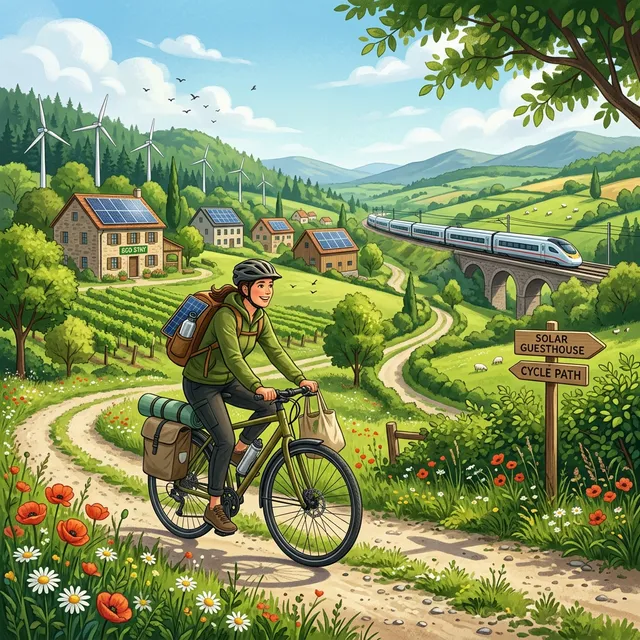
Sustainable travel has a branding problem. The phrase conjures images of earnest tourists carrying reusable water bottles through pristine forests, carefully separating recyclables at eco-lodges, and flying economy class on their way to a sustainability conference—an image that is simultaneously admirable and profoundly insufficient. The bamboo straw in your smoothie is not going to offset the 2.5 tonnes of CO₂ that your long-haul flight emitted to get you to the beach where you are sipping that smoothie. This arithmetic is not a reason to abandon sustainable travel practices; it is a reason to be honest about what those practices can and cannot accomplish, and to redirect energy from performative gestures to structural choices that actually reduce the environmental impact of tourism.
I have been writing about sustainable travel for three years, and the central tension I keep encountering is this: the people who care most about traveling sustainably are also the people who should be traveling, because they tend to be the travelers who engage most respectfully with local cultures, spend money in locally-owned businesses, and return home as advocates for the places they visited. The people who cause the most environmental damage through tourism—the cruise ship passengers, the package tour groups, the luxury resort guests whose per-capita resource consumption is orders of magnitude higher than local populations—are largely uninterested in sustainability discussions. This essay is for the first group: people who want to travel responsibly and want honest guidance about what that means in practice.
The Carbon Question: Let's Get the Big Number Out of the Way

Aviation is responsible for approximately 2.5% of global CO₂ emissions and approximately 3.5% of total warming effect (because aircraft also emit nitrogen oxides, water vapour, and particulate matter at altitudes where their warming effect is amplified). A single round-trip economy class flight from Delhi to London emits approximately 1.5-2.0 tonnes of CO₂ per passenger—roughly equivalent to three months of total carbon emissions for an average Indian citizen. This single fact dominates every honest discussion of sustainable travel: if you fly, you are generating emissions that no combination of bamboo straws, linen tote bags, and eco-lodge stays can meaningfully offset.
The honest responses to this fact are: fly less frequently and stay longer (one two-week trip rather than four long weekends); choose direct flights over connections (a significant portion of aviation emissions occurs during takeoff and landing); fly economy class (per-passenger emissions are 2-3x higher in business class because larger seats mean fewer passengers sharing the aircraft's total emissions); choose newer aircraft (Boeing 787s and Airbus A350s are approximately 20-25% more fuel-efficient than older aircraft types); and, for distances under 500-800 kilometres, consider train travel (which emits 80-90% less CO₂ per passenger-kilometre than aviation). In India specifically, the expanding network of high-speed and semi-high-speed rail routes—Vande Bharat Express covers most major routes at competitive journey times—makes train travel a genuine alternative to domestic flights for many routes.
Carbon offsetting—paying a third party to reduce or absorb CO₂ equivalent to your flight's emissions—exists and is better than nothing, but its effectiveness is contested. The best offset programmes fund renewable energy installations or forest protection that would not have occurred without the offset payment (this is called "additionality"). The worst offset programmes fund activities that would have happened anyway and therefore do not represent genuine emissions reductions. If you choose to offset, use programmes with Gold Standard or Verra VCS certification, which require independent verification of additionality and permanence.
Accommodation: Where Your Money Goes Matters More Than Where You Sleep
The most impactful accommodation choice for sustainable travel is not whether the hotel has a recycling programme or solar panels—it is whether your accommodation spending benefits the local economy or leaks out to international corporations and absentee investors. A locally-owned guesthouse, homestay, or independent hotel recirculates 60-80% of your spending within the local economy (through local employment, local food purchasing, local services). An international chain hotel recirculates 20-40% locally, with the majority flowing to corporate headquarters, international suppliers, and investor returns in other countries.
India's homestay ecosystem—particularly platforms like Airbnb (filtered for locally-owned properties), StayVista, and SaffronStays for curated experiences, and direct-booking options for heritage properties in Rajasthan, Kerala, and the Northeast—provides some of the world's best opportunities for locally-beneficial accommodation. A homestay in a Kumaoni village, a heritage haveli in Rajasthan's Shekhawati region, or a plantation stay in Coorg generates income directly for local families, provides employment for local staff, and creates economic incentives for communities to preserve their cultural heritage and natural environment rather than converting to more "modern" (and typically less culturally and ecologically valuable) development.
Water and energy consumption at your accommodation matters, particularly in water-stressed regions. The basic practices—reusing towels, limiting shower time, turning off air conditioning when absent—are widely promoted and genuinely impactful in aggregate. A luxury resort guest in Rajasthan who uses 500 litres of water per day (swimming pool, long showers, laundry service, landscaped gardens) is consuming more water than a local family of five uses in a week. Choosing accommodation with water-efficient practices (rainwater harvesting, greywater recycling, drip irrigation) reduces this disparity.
Food: The Most Delicious Sustainability Decision
Eating locally produced food at locally-owned restaurants is the sustainability decision that costs nothing, requires no sacrifice, and produces the best travel experiences. The tourist who eats breakfast at the hotel buffet (imported ingredients, industrial preparation), lunch at an international chain restaurant (standardised menu replicated identically in 60 countries), and dinner at a tourist-oriented restaurant (local cuisine modified for foreign palates and priced at 3x local rates) has spent money that contributes minimally to the local food economy and has eaten food that tells them nothing about the place they are visiting.
The alternative—eating at local restaurants, street food stalls, and markets where the food is prepared by local cooks, using local ingredients, for local customers at local prices—generates the genuine cultural engagement that sustainable tourism advocates and produces meals that range from very good to transcendently excellent. A thali at a family-run restaurant in Tamil Nadu, a plate of momos from a Tibetan stall in Dharamshala, a dosa from a street cart in Mysore—these meals are economically sustainable (your ₹80-150 supports a local family), environmentally sustainable (locally sourced ingredients with minimal transportation emissions), culturally authentic, and culinarily superior to anything the hotel buffet can produce.
The Tour Operator Question
If you book tours, activities, or experiences through a tour operator, the choice of operator determines the distribution of your spending at least as much as the activity itself. A locally-owned, locally-guided tour that charges ₹2,000 per person may retain ₹1,600 locally (paying the local guide, local transportation provider, and local entrance fees, with the remainder covering the local operator's business costs). The same tour booked through an international online platform may retain only ₹800 locally—after the platform's commission (15-30%), the international marketing company's margin, and the payment processor's fees are deducted. The experience for the tourist is identical; the economic impact for the community is halved.
Frequently Asked Questions (FAQs)
Is it possible to travel sustainably and affordably?
Yes—sustainable travel is often cheaper than conventional tourism. Locally-owned guesthouses and homestays cost 30-50% less than international chain hotels. Local restaurants cost 50-80% less than tourist-oriented restaurants. Public transportation and trains cost 70-90% less than private taxis and domestic flights. Walking tours and self-guided exploration cost nothing. The practices that reduce environmental impact—staying locally, eating locally, traveling by train, walking more—also reduce costs. The expensive sustainability options (eco-luxury resorts, carbon offsets, electric vehicle rentals) get disproportionate attention, but the most impactful sustainable practices are free or cheaper than the conventional alternatives.
Should I feel guilty about flying?
Guilt is not a productive framework for sustainability. Aviation emissions are a structural problem requiring systemic solutions (sustainable aviation fuels, electric aircraft development, carbon pricing, rail infrastructure investment), not individual solutions (personal guilt). Your individual decision to fly or not fly has negligible impact on global aviation emissions. Your decision about how frequently to fly, how to fly (economy vs. business, direct vs. connection), and how to compensate for your emissions is meaningful at the margin. The most productive approach is informed decision-making rather than guilt: understand the carbon cost of your travel choices, minimise where feasible, compensate where possible, and advocate for the systemic changes (rail investment, aviation fuel standards, carbon pricing) that would make sustainable travel the default rather than the exception.
What's the single most impactful sustainable travel practice?
Stay longer, travel slower. A two-week trip to one destination generates roughly the same transportation emissions as a two-week trip to four destinations but produces substantially less per-day emission intensity. Longer stays also produce better travel experiences (deeper cultural engagement, stronger local relationships, more complete exploration) and greater local economic benefit (more nights in accommodation, more meals purchased, more activities booked). The fast-travel pattern—three cities in seven days—maximises carbon per experience and minimises depth of engagement. The slow-travel pattern—one region in two weeks—minimises carbon per experience and maximises depth. The sustainability imperative and the quality-of-experience imperative point in the same direction.



Comments (0)
Be the first to share your thoughts on this article.