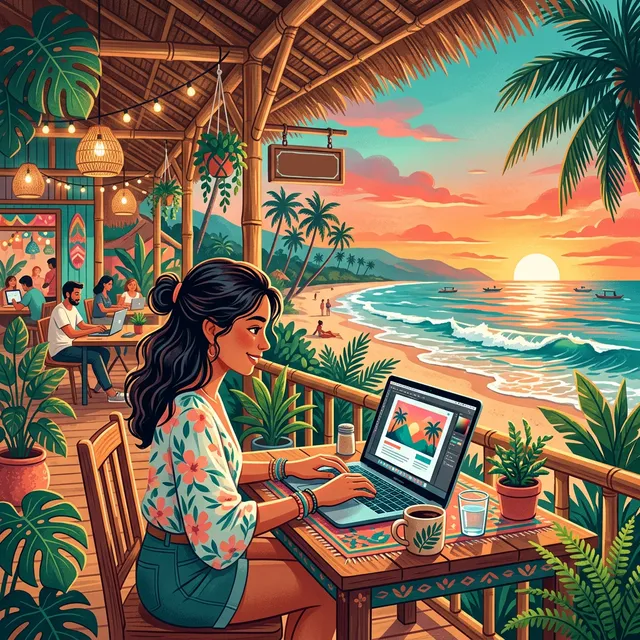
The digital nomad lifestyle has a public relations department that operates with ruthless efficiency. You know the outputs: the laptop-on-a-beach-in-Bali photograph, the co-working-space-with-mountain-view Instagram story, the "I make $10K/month working 4 hours a day from anywhere" YouTube thumbnail. These images and claims are not entirely false—people genuinely do work remotely from beautiful locations while earning good incomes—but they represent the digital nomad experience in the same way that a movie trailer represents a movie: by selecting the most compelling moments and omitting the overwhelming majority of the actual runtime, which consists of mundane problem-solving, logistical frustration, and the specific loneliness of being permanently between places without being fully in any of them.
I lived as a digital nomad for fourteen months across six countries—India, Thailand, Portugal, Georgia, Indonesia, and Mexico—before settling back in India with a hybrid arrangement. What follows is the survival guide that I wish someone had given me before I sold most of my possessions, packed a 40-litre backpack, and flew to Chiang Mai with the conviction that I had figured out a life hack that everyone else was too conventional to attempt. The conviction lasted approximately three weeks, at which point the reality of unstable Wi-Fi, timezone misalignment with clients, visa complications, and the existential question of what "home" means when you don't have one combined to produce a more nuanced—and ultimately more sustainable—understanding of location-independent work.
The Money Reality: What It Actually Costs

The digital nomad content ecosystem dramatically understates costs by omitting categories that don't exist in settled life. The monthly budget for a digital nomad in Southeast Asia—the most popular destination region—breaks down roughly as follows for a comfortable (not luxury, not backpacker) lifestyle: accommodation (₹25,000-50,000/month for a furnished apartment or co-living space with reliable Wi-Fi), co-working space (₹5,000-12,000/month—essential because apartment Wi-Fi is unreliable for video calls and concentrated work), food (₹15,000-25,000/month), local transportation (₹3,000-8,000/month), health insurance (₹5,000-10,000/month for international coverage like SafetyWing or World Nomads), visa costs (variable but significant—Thai tourist visas require border runs every 60-90 days, each costing ₹3,000-8,000 in transportation and fees), SIM cards and mobile data (₹1,000-3,000/month), and the hidden category that nobody budgets for: transition costs.
Transition costs—the expenses incurred when moving from one location to another—are the budget item that bankrupts naive digital nomads. Every relocation involves: flights or long-distance transportation (₹5,000-30,000 depending on distance), the first-and-last-month rent deposit on new accommodation (temporarily doubling your housing cost), the productivity loss of 2-3 days spent finding accommodation, setting up workspaces, and dealing with logistics in a new city, replacement purchases for items that didn't survive the move or that the new location requires, and the social capital reset cost of leaving whatever social network you built in the previous location and starting from zero in the current one. A digital nomad who moves monthly spends 30-40% more than one who stays in three-month blocks, and the financial difference between "nomad" and "slow traveler who works" is primarily a function of relocation frequency.
The Work Reality: Timezone Hell and Wi-Fi Roulette
The practical challenge of working while traveling is not motivation or self-discipline (if you lack these, you will discover the deficiency immediately and return to conventional employment within months). The challenge is infrastructure reliability. Your income depends on your ability to attend video calls, meet deadlines, upload deliverables, and communicate with clients or employers in real time. All of these activities depend on internet connectivity that is fast, stable, and available during the specific hours when your clients or employer expect you to be online.
In Southeast Asia, internet connectivity ranges from excellent (Bangkok's co-working spaces, Bali's Canggu digital nomad hub) to catastrophic (rural areas, smaller islands, most accommodation outside major tourist zones). The difference between "average 50 Mbps" in a co-working space listing and the actual 3 Mbps you experience during a video call at 2 PM when forty other nomads are also on video calls is the difference between a professional work environment and a source of constant anxiety. The practical mitigation is always having a backup: a local SIM card with a generous data plan as a mobile hotspot when Wi-Fi fails, tested before you need it for an important call.
Timezone management is the logistical challenge that most determines quality of life. If your clients or employer are in India (IST, UTC+5:30) and you are in Portugal (UTC+0/+1), your overlap working hours are approximately 1:30 PM to 6:30 PM Portugal time—meaning your mornings are free but your evenings are consumed by work, eliminating the social and cultural engagement that is theoretically the reason you chose to be in Portugal. If your clients are in the US (UTC-5 to UTC-8) and you are in Thailand (UTC+7), your overlap hours are roughly 8 PM to midnight Thailand time—meaning you work while everyone around you is socialising, and you sleep while everyone is active. The timezone that works best for Indian clients is neighbouring Asian countries (Thailand, Indonesia, Georgia)—stay within 2-3 hours of IST and the scheduling burden is manageable.
The Social Reality: Friendship on a Timer
The social life of a digital nomad operates on accelerated timelines. You arrive in a city, meet other nomads at co-working spaces and hostels, form intense friendships compressed by the awareness that everyone is temporary, and then—within weeks or months—either you leave or they do. The relationships are genuine but impermanent, creating a social experience characterised by perpetual beginning (the excitement of new connections) and perpetual ending (the sadness of departures that happen with metronomic regularity).
Over fourteen months, I made dozens of friends and lost meaningful contact with nearly all of them upon relocation. Not through conflict or incompatibility, but through the simple physics of social relationships: proximity creates connection, distance erodes it, and the cognitive cost of maintaining remote friendships across different timezones, different life phases, and different daily contexts is high enough that most people—including you, and including me—gradually let the contact frequency decrease until the relationship exists primarily as an Instagram follow and an occasional "we should catch up sometime" message that never materialises into an actual conversation.
The social antidote is the digital nomad community itself—the rotating cast of location-independent workers who constitute a distributed, globally mobile social network. In any major nomad hub (Canggu, Chiang Mai, Lisbon, Medellín, Tbilisi), you will encounter a community of nomads who share your lifestyle context: they understand the timezone complaints, the visa anxieties, the Wi-Fi frustrations, and the particular cocktail of freedom and rootlessness that defines the nomad experience. These communities are welcoming, inclusive, and genuinely supportive—but they are also transient, which means the community is consistent while the individuals within it are constantly changing.
The Visa Reality: Nobody Talks About This Enough
Most digital nomads work illegally. This is not an accusation—it is a statement of the regulatory reality. A tourist visa does not authorise work. If you enter Thailand on a tourist visa, sit in a café, and write code for a client in New York, you are technically working without a work permit—a violation of Thai immigration law. The enforcement is minimal (Thai authorities do not raid co-working spaces checking visa types), and the practical risk to individual nomads is low, but the legal ambiguity creates genuine anxiety and periodic enforcement crackdowns that can result in fines, deportation, or visa blacklisting.
The emergence of dedicated digital nomad visas (available in approximately 50+ countries as of 2026) is partially addressing this issue. Countries including Portugal, Spain, Estonia, Thailand (the Long-Term Resident visa), Indonesia (the B211A remote worker visa), and Georgia (which allows visa-free stays of up to one year for many nationalities) now offer legal frameworks specifically designed for remote workers. These visas typically require: proof of remote employment or freelance income (usually $1,500-3,000/month minimum), health insurance, a clean criminal record, and payment of a visa fee. The application process is bureaucratic but navigable, and the legal security is worth the administrative effort—particularly for nomads planning stays of three months or longer.
Frequently Asked Questions (FAQs)
How much money do I need to start as a digital nomad?
A minimum of 3-4 months of living expenses in savings before you begin, plus a reliable monthly income source. For Southeast Asia (the most affordable popular region), this means approximately ₹2-3 lakh in savings plus a monthly income of at least ₹60,000-80,000. For Europe or Latin America, increase the savings cushion to ₹3-5 lakh and the income minimum to ₹1-1.5 lakh. Do not begin nomadic life without both the savings buffer and the income source—arriving in a foreign country without financial reserves and discovering that your freelance pipeline has dried up is a crisis that is far worse at a distance from your support network than it would be at home.
What are the best cities for Indian digital nomads in 2026?
Bangkok and Chiang Mai (Thailand): affordable, excellent infrastructure, large nomad community, Indian food widely available, 1.5-hour timezone difference from IST. Bali/Canggu (Indonesia): strong nomad community, beautiful environment, affordable, but Wi-Fi can be unreliable outside dedicated co-working spaces. Tbilisi (Georgia): visa-free for one year for Indian passport holders, extremely affordable, excellent food, small but growing nomad community. Lisbon (Portugal): excellent infrastructure, vibrant culture, digital nomad visa available, but significantly more expensive than Asian options. Dubai (UAE): close timezone to India, excellent infrastructure, large Indian community, but high cost of living.
Is digital nomad life sustainable long-term?
For most people, no—at least not in the perpetually-mobile form that the lifestyle brand promotes. The average digital nomad returns to a fixed base within 18-24 months, either because the social costs (loneliness, relationship strain, friendship impermanence) exceed the benefits, because the logistical friction (visa management, accommodation searching, timezone juggling) becomes exhausting, or because life circumstances change (relationship, family, desire for community roots). The sustainable long-term model for most people is not permanent nomadism but "slow nomadism" or "location flexibility": maintaining a home base while spending 2-4 months per year working from different locations. This model preserves the benefits of location independence (novelty, cultural exposure, travel integration) while providing the stability, community, and administrative simplicity that full-time nomadism sacrifices.

Comments (0)
Be the first to share your thoughts on this article.